

Different city, different job, different person entirely — and somehow you're standing in the exact same relationship again. Either you're the one checking your phone too often while they need space, or you're the one pulling back while they chase. The faces change. The shape doesn't. At some point you stop thinking it's bad luck and start wondering if something about you keeps producing this exact result.
It's not bad luck, and it's not a flaw unique to you. Anxious and avoidant attachment styles pair up often enough that it's one of the most well-documented patterns in relationship psychology, and once you see the mechanism, it stops feeling mysterious. Attachment Styles Explained covers all four styles if this is new territory — this article is specifically about why these two particular styles keep finding each other.
This isn't a coincidence of dating pools or bad taste. It's closer to a magnet effect, where each style is drawn to specific qualities the other one happens to display early on — qualities that later turn out to be part of the exact problem.

Why do anxious and avoidant attachment styles keep pairing up?
Because, at least at first, each one looks like exactly what the other is scanning for.
Someone with an anxious style is watching for signs that closeness is safe and available. An avoidant partner's calm, self-sufficient exterior reads as security — steady, unshaken, not needy. Someone with an avoidant style, meanwhile, is quietly on guard against being smothered or overwhelmed. An anxious partner's warmth and attentiveness reads as safe, low-risk affection — someone who won't demand more than they're offering, at least not yet.
Neither person was lying about who they are in the beginning. The traits that attracted each of them are the same traits that eventually collide.
Both first impressions are, in a sense, accurate and incomplete. The avoidant partner really is calm — until closeness deepens and the calm turns into distance. The anxious partner really is warm — until the relationship's pace slows and the warmth turns into worry.
What does this pairing actually look like from both sides?
From the anxious side: the relationship starts to feel uneven early on. You're the one initiating, the one reaching out first, the one working to keep things warm. A partner's distance reads as a problem to solve, so you solve it by getting closer, which is the one move almost guaranteed to make an avoidant partner retreat further. The signs, causes, and paths out of anxious attachment covers what this experience looks like in more depth, including why the pursuit instinct is so hard to override in the moment.
From the avoidant side: the relationship starts to feel like pressure, even when nothing has gone wrong. Your partner's attentiveness, which felt nice at first, starts to feel like an expectation you can't quite meet, and the instinct to create space kicks in right as things are getting serious. Why avoidant attachment makes people pull away from those who love them explains that mechanism from the inside, including why it isn't really about not caring.
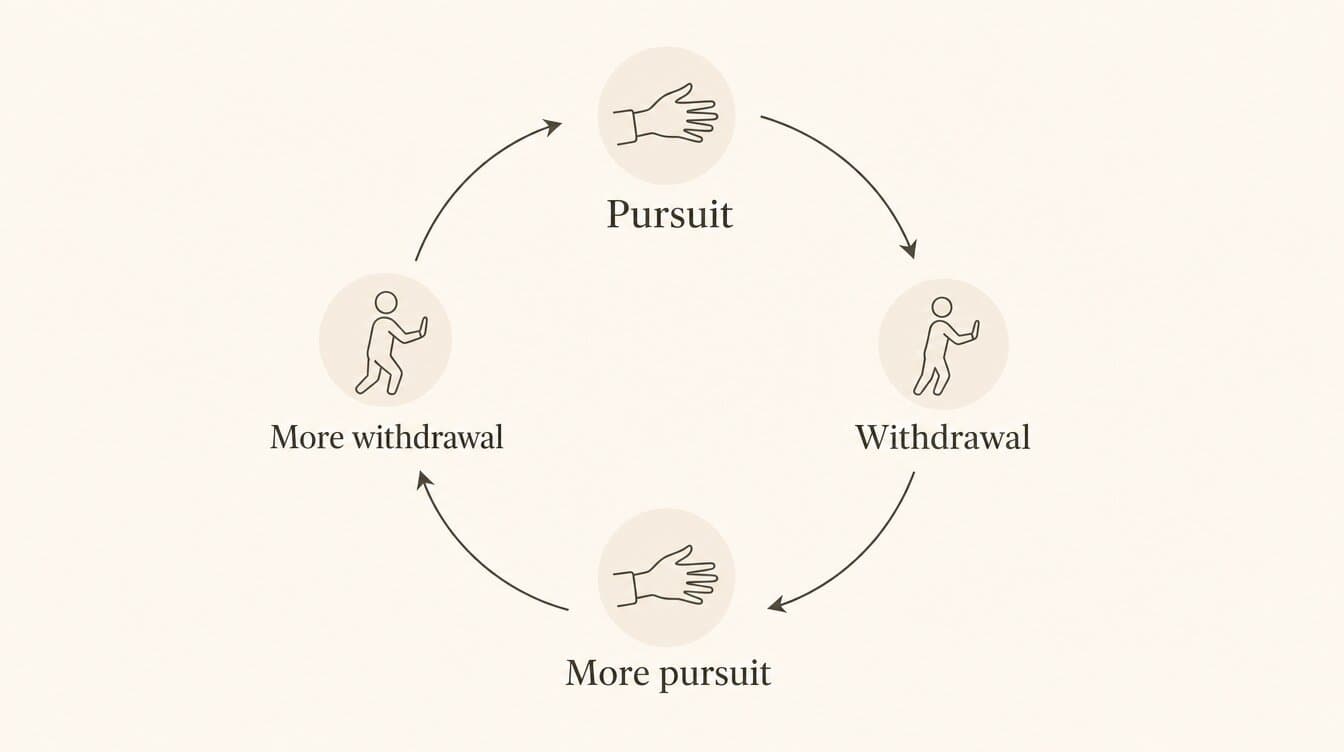
The loop: pursuit triggers withdrawal, withdrawal triggers more pursuit, and each person's coping strategy makes the other person's fear feel more justified. Both are responding rationally to what they're actually experiencing. Neither one is making it up.
Here's what that looks like end to end. A good weekend together leaves the anxious partner wanting more time, more contact, more of the closeness that just felt so good. They reach out more than usual — an extra text, a plan for next week, a question about where things are headed. The avoidant partner feels the increased weight of that reaching and starts pulling back — shorter replies, more time "needed," a sudden focus on being busy. The anxious partner notices the pullback and reaches further to close the gap. The avoidant partner feels the gap-closing as more pressure and pulls back further still. By the time either person names what's happening, both are convinced the other one caused it.
Can an anxious-avoidant relationship actually work?
Yes, and it's worth saying clearly, because a lot of what gets written about this pairing makes it sound doomed by default. It isn't. What it requires is both people understanding the loop clearly enough to interrupt their own half of it, rather than waiting for the other person to change first.
Concretely, that means the anxious partner learning to tolerate distance without escalating pursuit, and the avoidant partner learning to tolerate closeness without escalating withdrawal. Neither of those is comfortable, and neither happens overnight. But relationships between these two styles that actually work tend to share one thing: both people know what's happening in real time and can name it — "I'm in pursuit mode right now" or "I'm about to shut down" — rather than acting the pattern out silently and calling it a personality clash.
It also helps enormously if the anxious partner brings some genuine security to the relationship rather than pure need, and if the avoidant partner brings some genuine willingness to stay present rather than pure retreat. The combination is hardest when both people are deep in their respective patterns with no self-awareness attached. It's workable when at least one, ideally both, can catch themselves mid-loop.
Check yourselfThe internet usually picks a side in this dynamic. Before reading on: what is each person in the loop fairly accountable for, and what are they not?Show the answerHide the answer
Not the fear. Neither style chose it, and both fears are doing the job they were built for. What is fair to hold either person to is what they do once the fear is no longer a mystery — an avoidant partner who understands the loop and still refuses to engage with it is in a different position from one practicing closeness in small doses, and the same applies to an anxious partner who escalates every time distance appears.
Is one person more "at fault" in this dynamic than the other?
No, and this is worth being direct about, because the internet tends to pick a side — usually blaming the avoidant partner for being "cold" or the anxious partner for being "too much." Both framings miss the point. Neither style chose its fear on purpose, and both fears are doing exactly what they were built to do: protect against a version of pain that once felt very real.
Fault isn't in the fear. It's in what each person chooses to do once the fear is no longer a mystery.
What's fair to hold each person accountable for isn't the underlying fear. It's what they do with it once they're aware of it. An avoidant partner who understands the pattern and still refuses to engage with it at all is different from one actively working on tolerating closeness in small doses. An anxious partner who understands the pattern and still escalates every single time distance appears is different from one learning to sit with discomfort instead of immediately closing the gap.
How do you break the cycle if this keeps happening to you?
Start by noticing which half of the loop you tend to play, because most people have a consistent role regardless of who they're with. If you're usually the one pursuing, the pattern to interrupt is the urge to close distance the moment it appears. If you're usually the one retreating, the pattern to interrupt is the urge to create space the moment things feel real.
From there, the actual work is the same small, repeated practice either side requires: noticing the urge in the moment instead of only in hindsight, naming it out loud instead of acting on it silently, and choosing partners — where you have the choice — who are at least somewhat aware of their own pattern rather than completely unconscious of it. A relationship between two people who both understand the loop, even imperfectly, has a real shot. A relationship between two people who've never once named what's happening tends to just repeat the same shape with a new name attached.
It's also worth checking whether you're only ever drawn to the opposite style in the first place. That draw isn't random — it's often the nervous system reaching for whatever feels most familiar, even when familiar and healthy aren't the same thing.
Notice, honestly, whether the specific spark you're chasing is attraction — or the familiar anxiety of an unpredictable dynamic wearing attraction's clothing. Those two feelings can be genuinely hard to tell apart from the inside, especially early on, which is exactly why the pattern is so persistent.
Which half of the loop do you actually play?
Ticked: 0 of 5
The first item is the one that carries the others. Anything you left unticked is a description of the practice, not a verdict on you.
What to do next
The pattern repeats because both fears are real, both coping strategies make a kind of sense, and neither person set out to create the loop on purpose. That's also exactly why it's breakable — it's not fate, and it's not a character flaw baked into you. It's two understandable responses feeding each other, and understanding is the first real handle you get on stopping the cycle rather than just watching it repeat.

Test yourself
Question 1 of 3
You think back to the first two months, when your partner's calm felt like steadiness and your attentiveness seemed welcome. How does the article read those first impressions?
Why do anxious and avoidant attachment styles keep pairing up?
Because each initially looks like exactly what the other is scanning for. An avoidant partner's calm self-sufficiency reads as security to an anxious person. An anxious partner's warmth reads as safe, low-risk affection to an avoidant person. Both first impressions are accurate and incomplete — the same traits that attracted each of them are the ones that eventually collide.
What does the anxious-avoidant pairing look like from both sides?
From the anxious side: you're doing most of the initiating, and a partner's distance reads as a problem to solve — so you get closer, which triggers more retreat. From the avoidant side: attentiveness starts to feel like pressure, and the instinct to create space kicks in right as things get serious. Pursuit triggers withdrawal, withdrawal triggers more pursuit, and each coping strategy makes the other person's fear feel more real.
Can an anxious-avoidant relationship actually work?
Yes. What it requires is both people understanding the loop well enough to interrupt their own half of it, rather than waiting for the other to change first. The anxious partner learns to tolerate distance without escalating; the avoidant partner learns to tolerate closeness without escalating. Relationships between these styles that work tend to have both people naming what's happening in real time, not acting it out silently.
Is one person more at fault in the anxious-avoidant dynamic?
No. Neither style chose its fear, and both are doing exactly what they were built to do. What's fair to hold each person accountable for isn't the underlying fear — it's what they do with it once they're aware of it. Fault isn't in the fear. It's in what each person chooses to do once the fear is no longer a mystery.
How do you break the anxious-avoidant cycle?
Notice which half of the loop you consistently play. If you pursue, the practice is tolerating distance without chasing it. If you retreat, the practice is tolerating closeness without escaping it. Choose partners who are somewhat aware of their own pattern. And ask, honestly, whether the spark you keep chasing is attraction — or the familiar anxiety of an unpredictable dynamic wearing attraction's clothing.