

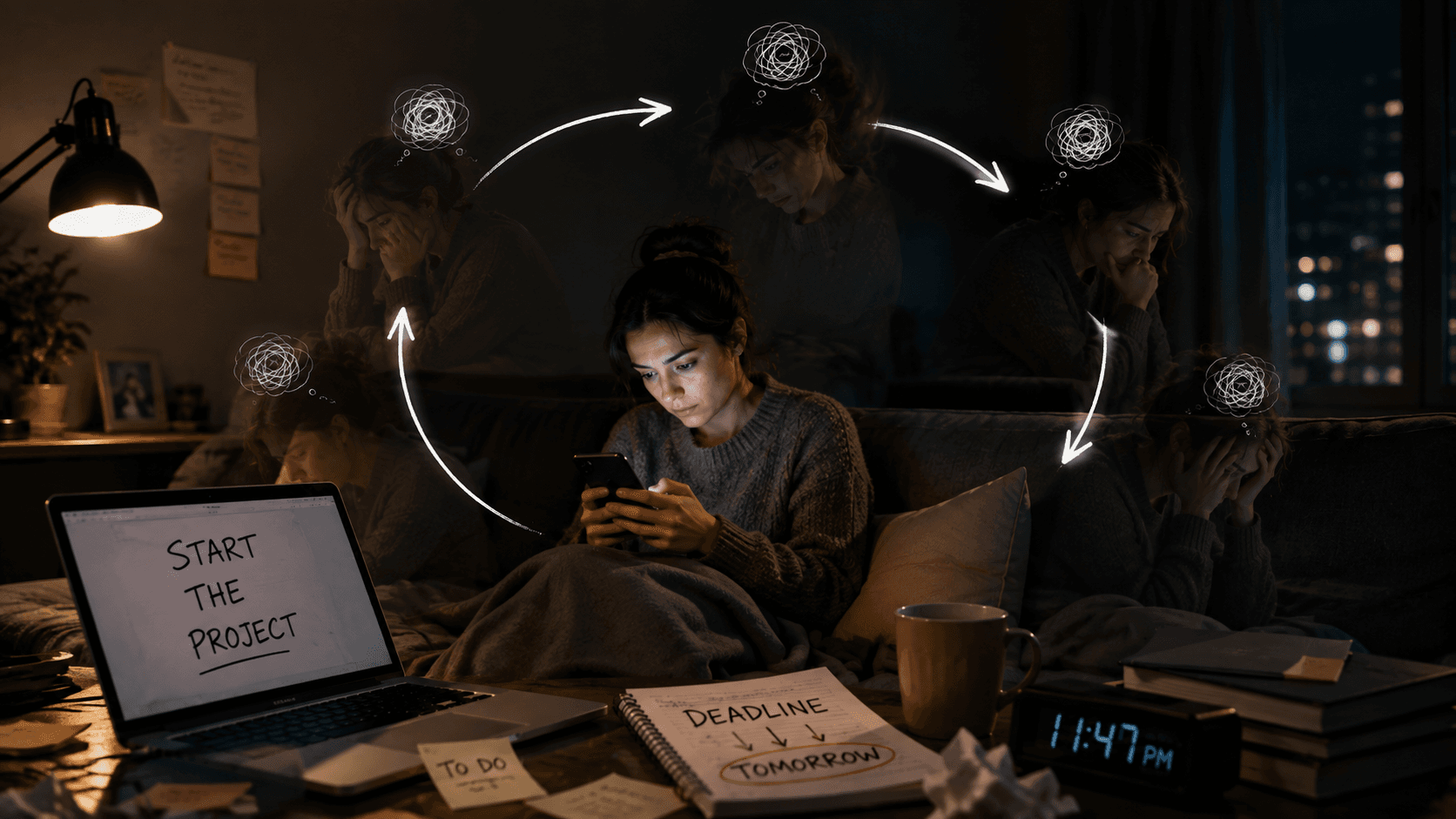
The task makes you anxious, so you don't start it. Not starting it gives you a moment of relief — and then, an hour later, a worse version of the same anxiety, now with the added weight of having wasted an hour. So you avoid it again. By evening you've spent more energy on the not-doing than the task would have taken, and the deadline is closer, and the whole thing feels heavier than it did this morning.
This is one of the most recognizable patterns in the psychology of procrastination, and it's genuinely a loop — each stage produces the conditions for the next. Understanding where the loop reinforces itself is what makes it possible to see where it comes apart.
It's also worth saying at the outset that the pattern is common enough to be considered ordinary rather than exceptional. Most people encounter some version of it, and encountering it doesn't indicate anything unusual about your discipline or capability.
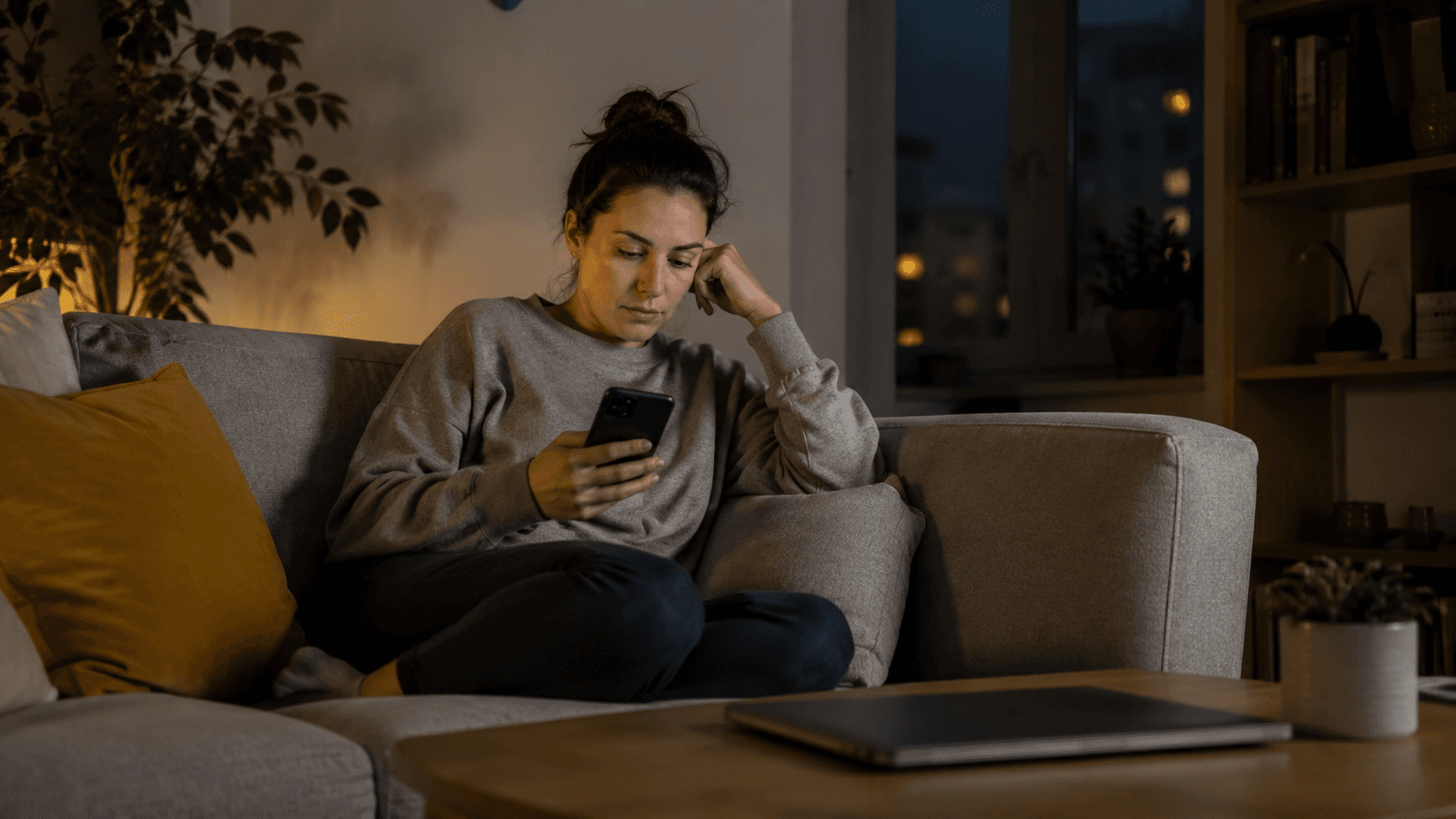
What is the procrastination-anxiety loop?
The procrastination-anxiety loop is a self-reinforcing cycle in which anxiety about a task drives avoidance, and avoidance in turn increases the anxiety, making the next attempt harder than the last.
The mechanism sits on top of the broader principle covered in our guide to why willpower fails against procrastination — that procrastination is fundamentally an emotion-regulation response rather than a time-management failure. Anxiety is simply the most common emotion in that role, and it happens to produce a particularly tight loop, because the relief from avoiding it is immediate and the cost is delayed.
How does the loop actually work, stage by stage?
It runs in a predictable sequence, and the sequence matters because each stage does something specific to make the next one more likely.
- 1The task triggers anticipatory anxiety. Thinking about the task produces discomfort — worry about doing it badly, uncertainty about where to start, or a sense that it will expose some inadequacy. The anxiety arrives before any work does.
- 2Avoidance produces immediate relief. Turning attention elsewhere makes the discomfort stop, right away. This relief is real and it's rewarding, which is exactly why the behavior sticks.
- 3The relief is quickly replaced by something worse. Guilt arrives, along with an awareness that the problem is still there and the available time has shrunk. The anxiety returns, now compounded.
- 4The task acquires additional emotional weight. It's no longer just a difficult task — it's a difficult task attached to guilt, self-criticism, and a growing sense of being behind.
- 5The next approach starts from a worse position. More anxiety now stands between you and starting than there was the first time. Avoidance becomes correspondingly more likely.
- 6The cycle repeats, tightening. Each pass through raises the emotional stakes, until the deadline forces action or the opportunity closes entirely.
| Stage | What happens | What it feels like | What gets reinforced |
|---|---|---|---|
| Trigger | The task comes to mind | Dread, tightness, resistance | The link between the task and discomfort |
| Avoidance | Attention moves elsewhere | Immediate relief | That avoidance works |
| Rebound | Guilt and awareness return | Worse than before | That the task is threatening |
| Accumulation | Task gains emotional weight | Heavier each time | That approaching it is costly |
| Repeat | Next attempt begins higher | Harder to start | The entire loop |
Check yourselfEscape is the intuitive response to something that makes you anxious, and clinical treatment of anxiety runs in the opposite direction. Before reading on, commit to a guess: what does that opposite direction ask of a person, and why would it work?Show the answerHide the answer
It asks for approach rather than escape — gradual, structured contact with the feared thing instead of relief from it. It works because approach is the only thing that delivers the information avoidance withholds: whether the task is as bad as expected, whether you can handle it, whether the feared outcome occurs at all. That information is what lets the fear response diminish. One caveat the article is careful about: in clinical settings a professional paces this work, so the principle explains the mechanism rather than prescribing an exercise.
Why does avoiding a task make the anxiety worse instead of better?
Because avoidance provides short-term relief while preventing the experience that would actually reduce the fear — and this is one of the best-established findings in the treatment of anxiety generally, not just procrastination.
The avoidance model at the center of cognitive behavioral therapy describes exactly this: when someone avoids a feared situation, their anxiety drops immediately, which reinforces the avoidance. But because they never encounter the situation, they never get the information that would update their expectation — whether it's actually as bad as anticipated, whether they could handle it, whether the feared outcome even occurs. The fear stays intact, unchallenged, and often grows, because the avoidance itself signals to the brain that the threat was real enough to warrant escaping.
Every time you avoid the task, you get relief. You also get confirmation that the task was worth avoiding. Both of those are learning.
This is why the therapeutic approach to anxiety runs in the opposite direction from intuition. Clinical work with anxiety disorders is built on gradual, structured approach to the feared thing rather than escape from it, because approach is what allows the fear response to diminish over time. That principle explains the mechanism here — though it's worth noting that in clinical contexts this work is done with a trained professional guiding the pacing, not as a self-directed exercise.
There's a detail in this worth noticing, because it explains why the loop can feel so unfair. The relief from avoidance is not imaginary or a failure of perception — it genuinely works, in the moment, exactly as your brain registers it. Avoidance is an effective short-term strategy. That's precisely the problem: strategies that work reliably in the short term are the hardest ones to unlearn, regardless of what they cost later.

Why is the anticipation usually worse than the task itself?
Because anticipatory anxiety — the dread that builds before an event — is frequently more intense than the discomfort experienced during the event, and this gap is one of the most consistently reported patterns in the anxiety literature.
Most people can verify this from their own experience. The half-hour spent dreading a difficult email is typically more unpleasant than the four minutes spent writing it. The task, once started, tends to be more ordinary than the version constructed in advance.
The loop keeps this from registering as useful information. If you consistently avoid the task, you never accumulate evidence that starting is less bad than anticipating — you only accumulate more anticipation. The gap between imagined difficulty and actual difficulty stays permanently untested.
A vague dread about "the report" contains every possible version of how it could go badly, all at once. The actual report is one specific document with one specific set of problems, most of them smaller than the imagined ones. The mind's version has no edges; the real thing does.
Astra Trainer's Psychology & Mind course has a full unit on interrupting this specific loop, working through the mechanics in short lessons rather than a single sitting. It's worth a look if the pattern above reads uncomfortably like a description of your week.
Where does the loop actually break?
At two points primarily: the moment of anticipation, and the moment after a lapse.
At the point of anticipation. The loop depends on the anxiety before starting being large enough to make avoidance worthwhile. Anything that lowers the perceived cost of starting reduces that gap. In practice, research on procrastination suggests that dramatically reducing the size of the initial step tends to matter more than increasing motivation, since the resistance is concentrated at the entry point rather than distributed across the whole task.
At the point after a lapse. This is where most cycles tighten, and it's addressed below — the response to having avoided is where the loop either escalates or loses momentum.
There's a third, less obvious point: the story attached to the avoidance. Interpreting a delayed task as evidence of laziness or a broken character adds emotional weight that makes the next approach harder, whereas recognizing it as a predictable emotional response tends not to. The interpretation itself feeds the loop.
A fuller framework for working with the pattern over time covers how these pieces fit together beyond a single instance.
Why does self-criticism keep the loop running?
Because guilt and self-attack are themselves negative emotions, and negative emotions attached to a task are what generate avoidance in the first place. Criticizing yourself for procrastinating adds to the exact thing that caused the procrastination.
Research by Fuschia Sirois has repeatedly found that self-compassion is associated with lower levels of procrastination, while harsh self-criticism tends to be associated with more. The finding runs against most people's intuition — the assumption being that easing up would mean doing even less — but the mechanism is mechanical rather than sentimental. A task carrying guilt is heavier than the same task carrying only its original difficulty.
Self-criticism after a lapse doesn't function as a corrective. It functions as more weight on the thing you were already struggling to lift.
Worth being precise about what self-compassion means in this context, since the term invites misreading: it isn't lowering standards or deciding the task doesn't matter. It's closer to responding to your own lapse the way you'd respond to a friend describing the same lapse — accurately, without the additional layer of contempt. The standards stay. The extra weight doesn't.
Run this against one task you have been avoiding
Ticked: 0 of 5
There is no pass mark here. Each tick names one place the loop is currently being fed, and the last one is usually the most useful: it means the comparison between the dread and the task has never been made.
When is the anxiety part worth talking to someone about?
When the anxiety is persistent, intense, and noticeably affecting daily functioning — work, relationships, sleep, or general wellbeing — rather than showing up around specific difficult tasks.
This isn't a diagnostic threshold and this article isn't in a position to assess any individual situation. Anxiety disorders are among the most extensively studied and most treatable conditions in mental health — a pattern interpreted for years as a personal failing sometimes has an explanation that responds well to appropriate support.
What to take from this
The loop holds together because each stage rewards the behavior that produces the next one — relief reinforces avoidance, avoidance produces guilt, guilt makes the task heavier, and the heavier task produces more anxiety. Seeing it as a mechanical sequence rather than a personal failing is genuinely useful, partly because it's more accurate, and partly because the alternative interpretation is itself one of the things keeping the cycle turning.

Test yourself
Question 1 of 3
You avoid a difficult email all afternoon and feel noticeably better each time you turn away from it. According to the avoidance model described here, what has the afternoon taught you?
What is the procrastination-anxiety loop?
A self-reinforcing cycle where anxiety about a task drives avoidance, and avoidance increases the anxiety, making the next attempt harder than the last. Each stage produces the conditions for the next.
Why does avoiding a task make the anxiety worse instead of better?
Avoidance provides real short-term relief but prevents the experience that would update the fear — whether the task is actually as bad as anticipated. The relief reinforces avoidance while the fear stays intact and often grows.
Why is anticipation usually worse than the task itself?
Anticipatory anxiety is frequently more intense than the discomfort of actually doing the task — a well-documented pattern in the anxiety literature. The loop prevents this from registering, since consistent avoidance means you never collect evidence that starting is less bad than anticipating.
Where does the procrastination-anxiety loop actually break?
At the moment of anticipation (by lowering the perceived cost of starting, often through a smaller first step), and at the moment after a lapse (through how you respond to having avoided, rather than escalating self-criticism).
Why does self-criticism keep the loop running?
Guilt and self-attack are themselves negative emotions, and negative emotions are what generate avoidance in the first place. Research consistently finds self-compassion associated with less procrastination, while harsh self-criticism feeds the cycle.