

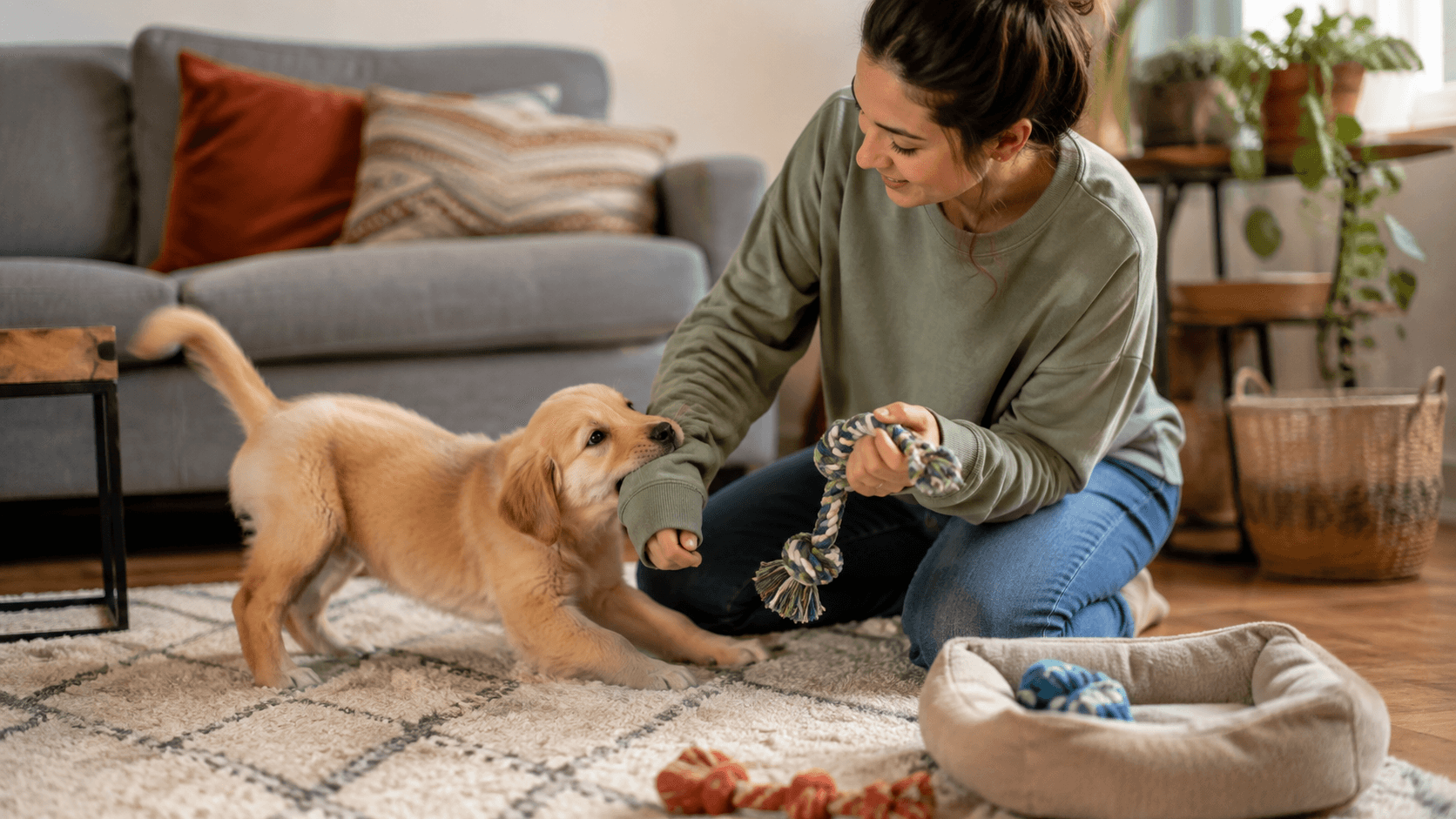
Your hands look like they've been through a hedge. Your sleeve has a new hole in it. You've tried three different things you read online and none of them have made the slightest difference, and somewhere around the fourth bite of the afternoon, a genuinely unfair thought creeps in: is this dog actually aggressive?
Almost certainly not. Puppy biting is close to universal — nearly every puppy does it, hard, for months — and it isn't a preview of an aggressive adult dog. It's a completely different subject from the warning signs that lead to an adult bite, which is about escalating discomfort in a mature dog. This is about a young animal that hasn't finished building a skill yet.
It's worth saying plainly, because the worry itself causes real damage: owners who become convinced their mouthy puppy is dangerous sometimes reach for harsh corrections out of fear, which can do more to shape a fearful, defensive adult than the mouthing itself ever would have.
Why do puppies bite and nip so much?
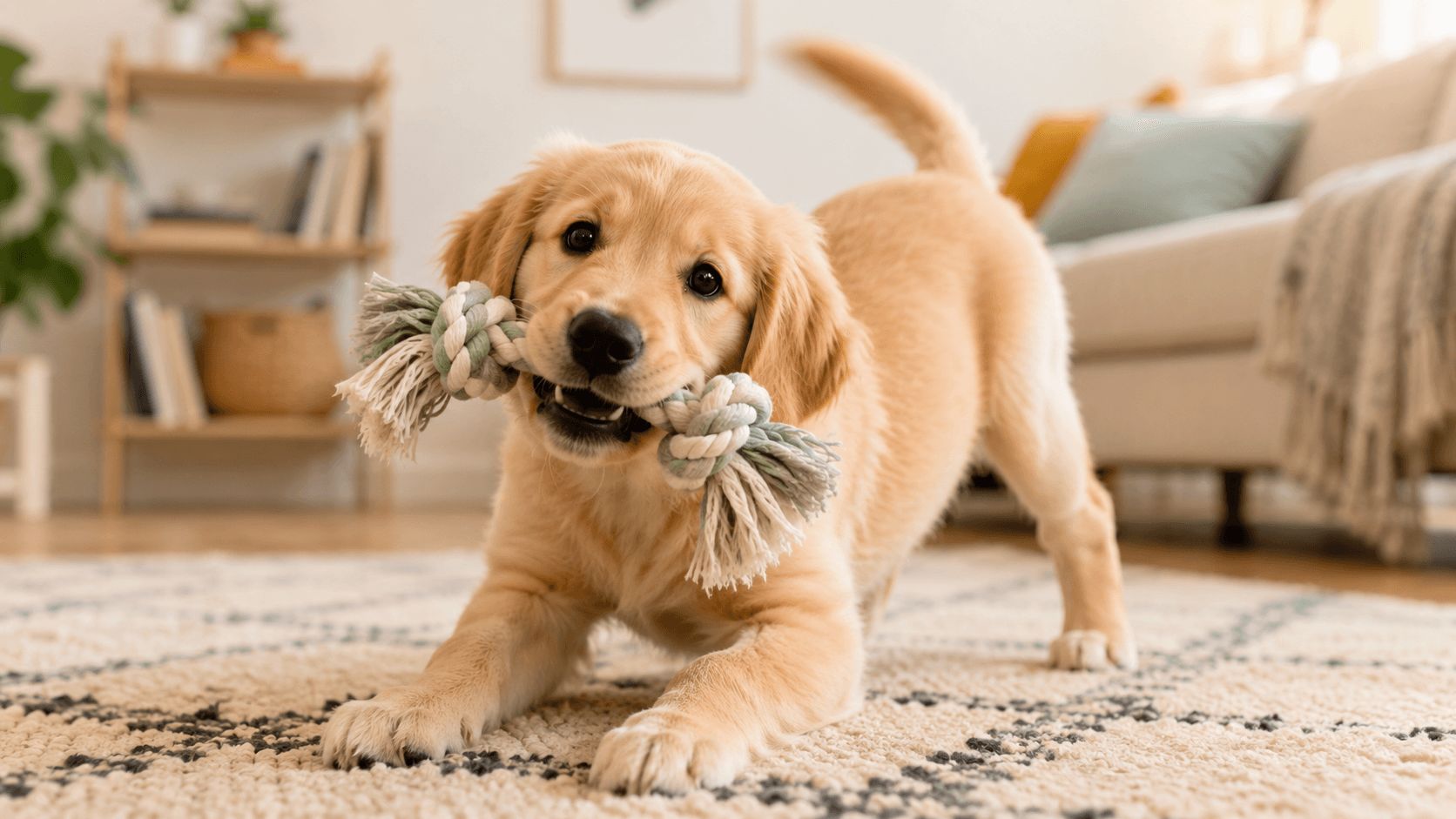
Because mouthing is how puppies explore the world, play with each other, and — critically — learn how hard is too hard. It isn't misbehavior. It's closer to a toddler's hands: the primary tool a puppy has for interacting with everything around it, including you.
Two physical factors add fuel to this. Puppies go through a teething period, roughly from a few weeks old through around six months, and sore gums make chewing on something — anything — genuinely soothing. And puppies raised with littermates learn early that biting too hard gets a yelp and an abrupt end to play, which is part of how the skill develops in the first place. A puppy separated from littermates early, or an only puppy, sometimes arrives at a new home with less of that feedback already built in.
A puppy's mouth is not a weapon it's chosen to use on you. It's the only tool it has, and it's still learning the settings.
Is puppy biting a sign of aggression?
No, and this is worth taking seriously, because the fear itself causes real harm — owners who panic about "aggression" sometimes reach for punishment-based corrections that can genuinely create the defensive behavior they were afraid of in the first place.
Aggression involves a dog trying to increase distance from something it perceives as threatening — the escalation pattern covered in why dogs bite. Puppy mouthing is the opposite: it happens during play, during exploration, during over-excitement, generally with a loose, wiggly body rather than a stiff, defensive one. A puppy chewing on your hand while its whole back end is wagging is not the same animal, or the same behavior, as an adult dog freezing before a defensive bite.
Check yourselfTwo adult dogs bite once, each in a moment of real pain. One mouthed constantly as a puppy on tolerant hands; the other was corrected out of mouthing by ten weeks. Before reading on, predict which bite does more damage, and why.Show the answerHide the answer
The dog corrected out of it, most likely. Jaw control is calibrated by mouthing and getting immediate feedback on force, so a puppy stopped before that practice learned to suppress the behavior rather than to grade the pressure. Months of practice on tolerant human hands is what leaves an adult dog with settings between nothing and full force, and a grown dog cannot build that anywhere near as well from scratch.
What is bite inhibition, and why does it matter more than making the biting stop immediately?
Bite inhibition is a dog's learned ability to control the force of its own bite — and according to veterinarian Ian Dunbar, whose work shaped how this is understood, it's arguably the single most important thing a dog learns in its entire life, more important even than basic obedience.
Here's the counterintuitive part. The goal during puppyhood isn't to stop mouthing as fast as possible — it's to let the puppy keep practicing, while teaching it that hard bites end the fun immediately, so the force gets dialed down over time. A puppy that's punished into never mouthing at all, before it's had the chance to learn bite inhibition, hasn't necessarily learned anything about how to control its jaw. It's just learned to suppress the behavior in that moment.
If that same dog is ever in real pain or genuinely frightened as an adult — the two most common triggers for a defensive bite — it may not have the calibrated bite control that a puppy who mouthed extensively, and got consistent feedback about pressure, would have developed.
This is why the timing matters so much. Dunbar's framing treats early mouthing as a training opportunity, not just a problem to eliminate — the puppy is actively building a skill that a fully grown dog cannot build from scratch nearly as well. A dog that never mouthed as a puppy, and then bites hard as an adult in a moment of genuine pain or fear, may inflict far more damage than a dog that spent months practicing on tolerant human hands and learning exactly how much pressure is too much.
What actually helps reduce puppy biting?
A combination of consistent feedback, redirection, and simply giving the behavior somewhere appropriate to go — rather than trying to eliminate it outright.
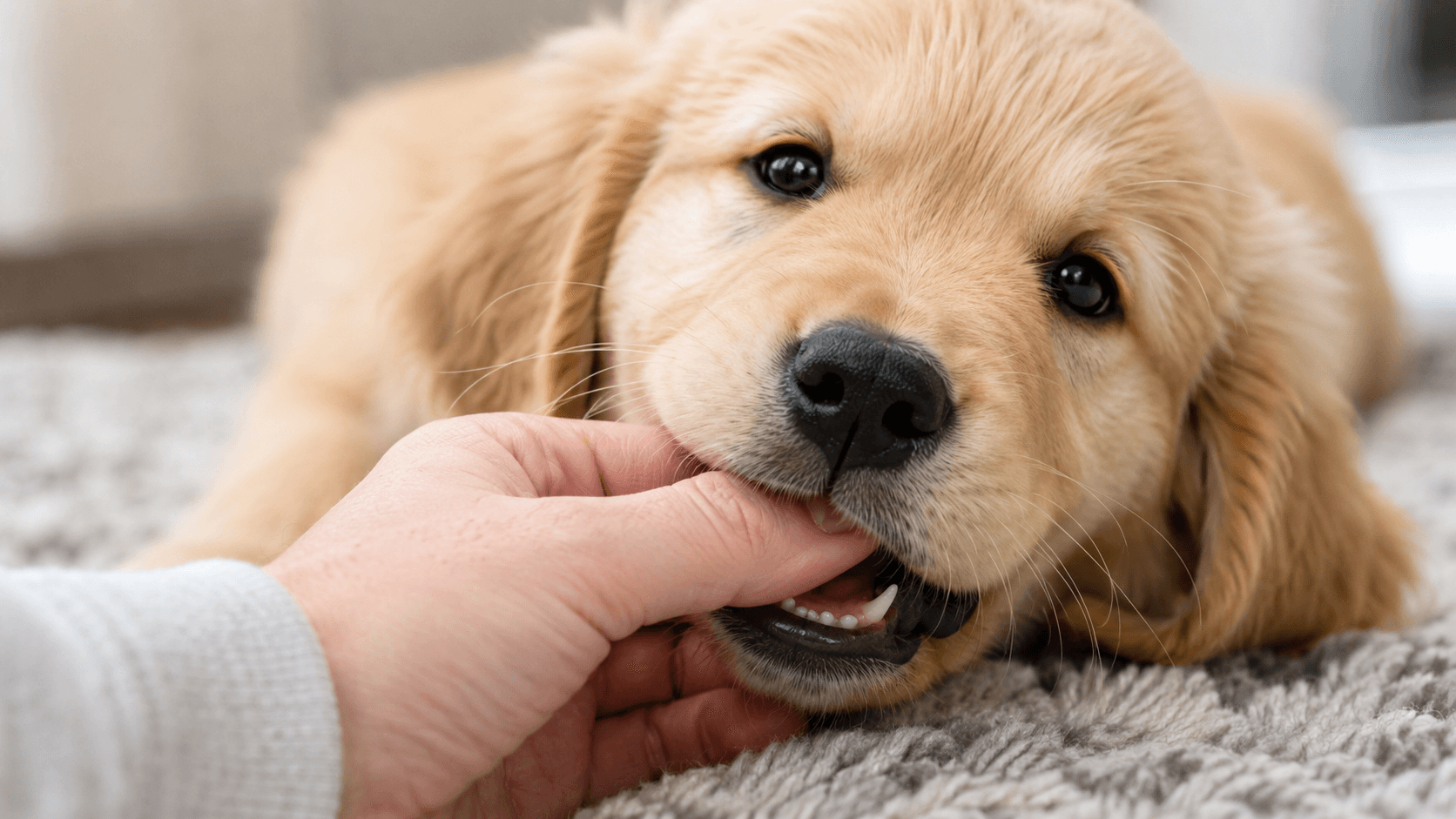
- A clear, calm response to pressure. A short, sharp sound — a yelp-like "ow" — followed by briefly withdrawing attention, mimics the feedback a littermate would give. Puppies generally recalibrate to gentler pressure over repeated instances of this kind of response.
- Redirecting to an appropriate object. The moment teeth land on skin, offering a toy or chew item gives the mouthing somewhere to go instead of just trying to suppress it. Puppies that are teething in particular tend to settle noticeably once they have something appropriate and satisfying to gnaw on.
- Managing arousal levels. Biting tends to spike when a puppy is overtired or overstimulated, similar to a small child getting cranky past a certain point. Ending play sessions before a puppy is fully wound up reduces how often the most intense biting shows up in the first place.
- Consistency across the household. If one person tolerates rough mouthing and another doesn't, the puppy gets a confusing, inconsistent picture of what's actually expected.
- Structure and predictability more broadly. A puppy with a reasonably predictable daily rhythm — regular exercise, regular rest, clear expectations — tends to have an easier time regulating itself generally, biting included. Basic obedience and structure at home isn't a biting fix on its own, but it gives a puppy's energy somewhere organized to go.
What should you avoid doing when a puppy bites?
Avoid any physical correction — holding the muzzle closed, tapping or hitting the nose, "alpha rolling" the puppy onto its back, or any method built around physical dominance. Modern behavioral science, including the position of the American Veterinary Society of Animal Behavior, has moved firmly away from these methods, and for good reason: they don't teach bite inhibition, and they carry a real risk of teaching a puppy that hands approaching its face are something to be afraid of.
Also worth avoiding: escalating your own reaction with anger or panic, which tends to read to a puppy as exciting rather than corrective and can intensify the behavior rather than calm it. And avoid completely withdrawing from play or handling out of frustration — a puppy still needs handling and socialization during this period, just with clearer, calmer boundaries around the mouthing specifically.
Check your own week at home against this
Ticked: 0 of 6
Three or four ticks is the ordinary starting point in the first weeks. The fourth item is the one households miss most often, and it quietly undoes the others. If the fifth is unticked, start there: it is the only line on this list that can make things worse rather than merely slower.
When does puppy biting normally stop?
Most puppies show a real, noticeable decline somewhere in the four-to-six-month range, as adult teeth come in and the worst of the teething discomfort passes, and it continues improving with consistent handling through the following months. Exact timing varies by individual puppy and by breed, and there's no fixed date this resolves by.
The AVSAB has been explicit that the risk of a poorly socialized adult dog generally outweighs the risks of controlled early socialization, and that window closes earlier than most new owners expect — often by around three to four months. Keep a mouthy puppy engaged in supervised social experiences during this stretch.
When is puppy biting cause for real concern?
If biting is still frequent and hard past roughly seven to eight months, if it's getting more intense rather than less over time, if it happens alongside stiff body language or genuine attempts to increase distance rather than playful engagement, or if a bite breaks skin outside of normal rough play, that's worth a conversation with a veterinarian or a certified professional rather than continuing to manage it alone. A vet visit also makes sense if there's any possibility of pain contributing.
None of this requires you to be someone you're not, and none of them are manipulative in the way they might sound at first — consistent, calm redirection gets there faster than frustration does, and the behavior that feels endless right now has a genuine endpoint most owners reach without realizing how close they were.

Test yourself
Question 1 of 3
Your twelve-week-old puppy grabs your sleeve during play. The whole back end is wagging and the body is loose. Which reading fits the article?
Why do puppies bite and nip so much?
Mouthing is how puppies explore the world, play, and learn how hard is too hard — it's their primary tool for interacting with everything, similar to a toddler's hands. Teething discomfort and reduced littermate feedback in early-separated puppies both add fuel to it.
Is puppy biting a sign of aggression?
No. Aggression involves increasing distance from a perceived threat. Puppy mouthing happens during play and exploration, generally with a loose, wiggly body rather than a stiff, defensive one — a completely different behavior from an adult bite.
What is bite inhibition and why does it matter?
The learned ability to control bite force — arguably the most important thing a dog learns in its life. The goal isn't stopping mouthing fast, but letting a puppy practice while teaching that hard bites end the fun, so pressure gets calibrated over time.
What actually helps reduce puppy biting?
A clear, calm response to pressure (a short yelp sound plus briefly withdrawing attention), redirecting to an appropriate chew object, managing arousal levels before a puppy gets overtired, and consistency across everyone in the household.
When does puppy biting normally stop?
Most puppies show real decline in the four-to-six-month range as adult teeth come in, continuing to improve through following months with consistent handling. Exact timing varies by individual puppy and breed.