


Here's a moment you've probably lived. A number is on the table — a salary, a price, a deadline, a "final offer" — and you know, somewhere in your gut, that you should push back. And you don't. You say "that sounds fine," you smile, and you spend the next three days replaying it, doing the math on what agreeing so fast just cost you.
That reflex isn't a personality defect. It's the predictable result of never being taught the one skill that quietly decides how much money you make, how you're treated at work, and whose terms you live on. School covered the quadratic formula and skipped the conversation where you ask for more. This article is that missing lesson: what negotiation skills actually are, why they feel so uncomfortable, and the core moves that separate people who get what they ask for from people who hope to be offered it.
None of this requires becoming pushy, fake, or someone you're not. Good negotiation is mostly preparation and a few learnable habits. Astra Trainer's Negotiation course walks through the exact scripts and situations in this article, with practice on real requests, but you can start with the fundamentals right here.

What are negotiation skills, exactly?
Negotiation skills are the set of abilities that let two or more people with different wants reach an agreement — ideally one that leaves everyone better off than no deal at all. That's it. It isn't a talent for smooth talk or a willingness to bully. At its core, negotiation is a structured conversation about how to divide something, or how to solve a problem together, when your interests and someone else's don't perfectly line up.
Most people picture negotiation as a battle: two sides, one winner, someone walks away burned. That image is exactly why it feels so unpleasant, and it's mostly wrong. The most influential book in the field, Getting to Yes by Roger Fisher, William Ury, and Bruce Patton out of the Harvard Program on Negotiation, spent its whole argument dismantling that picture. Their core move was to separate the people from the problem — to treat the other side not as an opponent to defeat but as a co-author of a solution you both have to live with.
These are skills, not traits. You can be quiet, conflict-averse, and deeply uncomfortable with all of this, and still get good at it.
The skills themselves break down into a handful of learnable pieces: preparing properly, understanding what the other side actually wants, knowing your own alternatives, making the first move well, listening in a way that lowers tension, and knowing when to walk. We'll get to each.
Check yourselfYou agree faster than you meant to, and you put it down to disliking conflict. Before you read on: what else does the article say is running in the background when a number lands in front of you?Show the answerHide the answer
A rule most people absorbed early and without noticing — that asking for more is rude, and that a good person takes what is offered and is grateful. It arrives dressed as manners, but it protects the other side's comfort at the direct expense of your outcomes, and it runs quietly every time a number appears. The fear is doing something simpler alongside it: pushing you to end the discomfort as fast as possible, which usually means agreeing.
Why does negotiation feel so uncomfortable?
Because for most people it triggers a genuine fear response — fear of conflict, fear of rejection, fear of seeming greedy — and that fear is doing exactly what fear does: it pushes you to end the discomfort as fast as possible, usually by agreeing.
This matters because the discomfort gets misread as a signal that you're bad at negotiating, or that negotiating isn't "you." It isn't either. It's the same thing a beginner feels before public speaking or a hard conversation. The physical unease is real, and it's also not evidence about your ability. It's evidence that the stakes feel high, which they often are.
There's a second reason it feels worse than it should. Many of us absorbed, early and without noticing, a rule that asking for more is rude — that a good person takes what's offered and is grateful. That rule protects other people's comfort at the direct expense of your own outcomes, and it runs quietly in the background every time a number lands in front of you.
The fix isn't to feel no fear. It's to prepare well enough that you can act despite it. Confidence in negotiation is downstream of preparation, not personality.
It's worth pausing on one specific version of this discomfort, because it trips up capable people constantly: the fear that negotiating will make the other side dislike you, or withdraw the offer entirely. In the overwhelming majority of professional negotiations, this fear is wildly out of proportion to reality. A reasonable counterpart expects some back-and-forth; a single polite request for more almost never blows up a deal that was otherwise going to happen. The catastrophe you're picturing — the offer yanked, the relationship soured — is real in perhaps a tiny fraction of cases, and even then usually only when the ask was delivered as an aggressive ultimatum rather than a reasonable question. Knowing that the downside is smaller than it feels doesn't remove the fear, but it does make it easier to act anyway.
What is BATNA, and why does it matter more than confidence?
BATNA stands for your Best Alternative To a Negotiated Agreement — the thing you'll do if this particular deal falls through. It's the concept from Getting to Yes that changed how professionals think about leverage, and it matters more than confidence, charisma, or nerve, because it's the one thing that's actually true regardless of how you feel in the room.
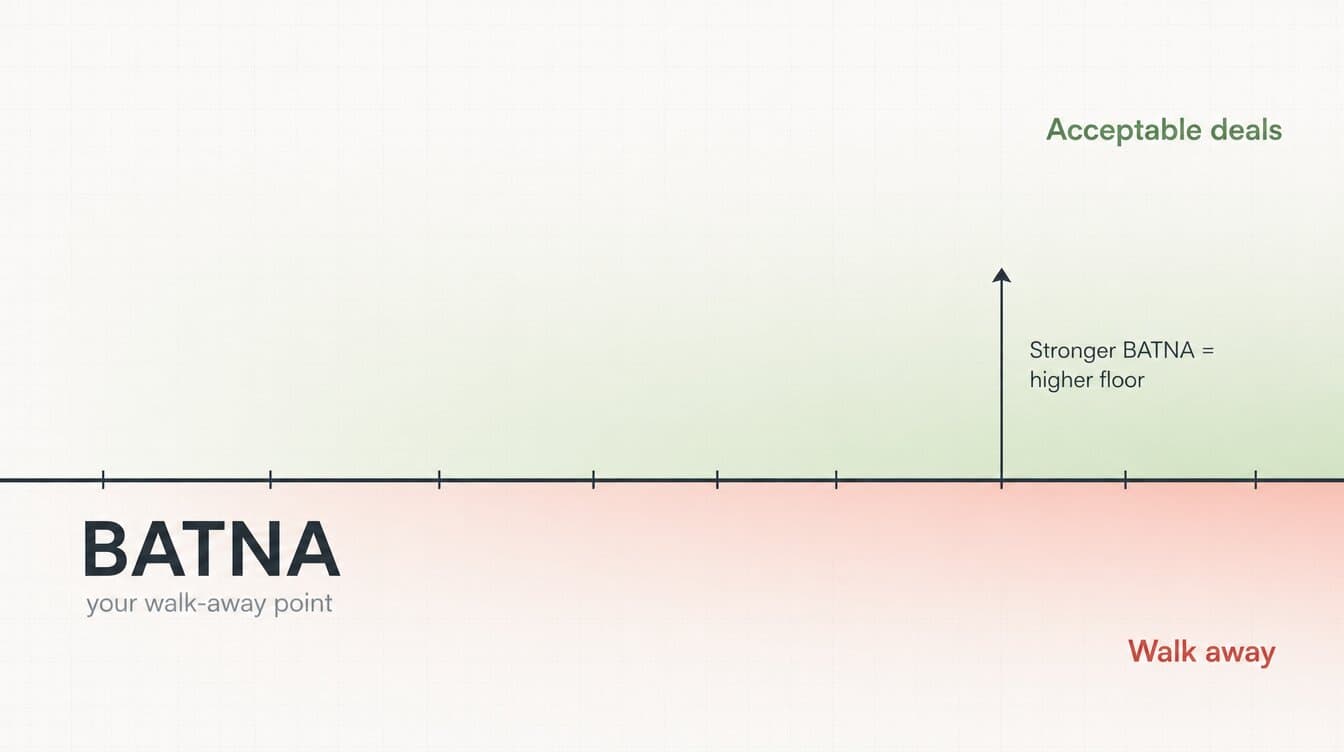
Here's the logic. Your power in any negotiation doesn't come from wanting the deal more or talking tougher. It comes from how good your alternative is. If you're negotiating a job offer and you have two other offers in hand, you can walk, and everyone in the room knows it. If it's your only offer and rent is due, your position is weaker no matter how confident you sound. The strength of your BATNA sets the floor for what you should accept.
This reframes the whole game in a useful way. Instead of trying to feel braver, you work on your alternatives before you ever sit down. You line up other options. You find out what you'd actually do if you said no. And often, just knowing your BATNA clearly — even a modest one — settles the nerves better than any pep talk, because your willingness to walk stops being a bluff and becomes a fact.
Two rules follow: never negotiate without knowing your own BATNA, and spend some effort estimating the other side's BATNA too, because their alternatives set the limits on what they can offer you.
A quick example shows how much this changes. Imagine two people negotiating the same salary for the same role. The first walks in thinking "I really hope they say yes to €65k." The second walks in knowing "if this falls through, I have a standing offer elsewhere at €60k, and I'd be fine taking it." The second person isn't more confident by temperament — they're anchored to a real floor. They can ask for €70k and mean it, because a "no" doesn't leave them stranded. The first person will often accept the first number offered, because in their own mind, the alternative to this deal is nothing. Same role, same words available to both, completely different outcomes — and the only difference is that one of them did the work of building an alternative before the conversation started.
This is why "just be more confident" tends to fail. Confidence you manufacture in the moment evaporates under pressure. Confidence that comes from a genuine alternative holds — because it's not a feeling you're performing, it's a fact about your situation.
What are the core principles of a good negotiation?
The core principles come down to four moves that the Harvard team laid out, and they work in almost any negotiation, from a salary talk to a disagreement with a contractor. The through-line is that you argue about the problem, not about who's a better person.
- Separate the people from the problem. The other side isn't your enemy; the disagreement is the thing to solve. When you stop treating a hard negotiation as a personal fight, you stop needing to win and start being able to think.
- Focus on interests, not positions. A position is what someone says they want ("I need €70,000"). An interest is why they want it (security, recognition, a fair comparison to peers). Positions clash head-on. Interests often don't, and once you understand the interest underneath a position, you can usually find more than one way to satisfy it.
- Invent options for mutual gain. Before deciding, generate several possible deals. Salary is rarely the only variable — there's signing bonus, start date, title, remote days, review timing, equity. A negotiation stuck on one number is often one that hasn't looked for the other movable pieces.
- Insist on objective criteria. Instead of a contest of stubbornness, anchor the discussion to something outside either person's will — market rates, comparable deals, published data. "Here's what this role pays at similar companies" is far harder to wave away than "I want more."
The difference between positions and interests is worth making concrete, because it's where most negotiations quietly go wrong:
| Arguing positions | Arguing interests | |
|---|---|---|
| What's on the table | Fixed demands ("€70k, final") | The reasons behind the demand |
| Feels like | A tug-of-war | A shared problem |
| Room to move | One number, up or down | Many variables to trade |
| Typical outcome | Someone loses, resentment lingers | A deal both sides can defend |
| When it breaks down | Immediately, over the number | Rarely, because reasons overlap |
If you want to see these principles applied to the highest-stakes conversation most people ever have, a salary negotiation script that actually works turns all four into specific words you can say.
How do you negotiate without being aggressive?
You listen more than you talk, you name the other side's concerns out loud before they have to, and you ask questions instead of making demands. Aggression is actually a sign of weak technique, not strong — it's what people reach for when they don't have better tools.
The best modern source on this is Chris Voss, a former lead FBI hostage negotiator, whose book Never Split the Difference argues that empathy is a tactic, not a soft skill. His central idea, tactical empathy, means understanding the other side's perspective well enough to name it accurately — not to agree with it, but to show you've genuinely heard it. When the other person feels understood, their defensiveness drops, and a defensive person never makes concessions.
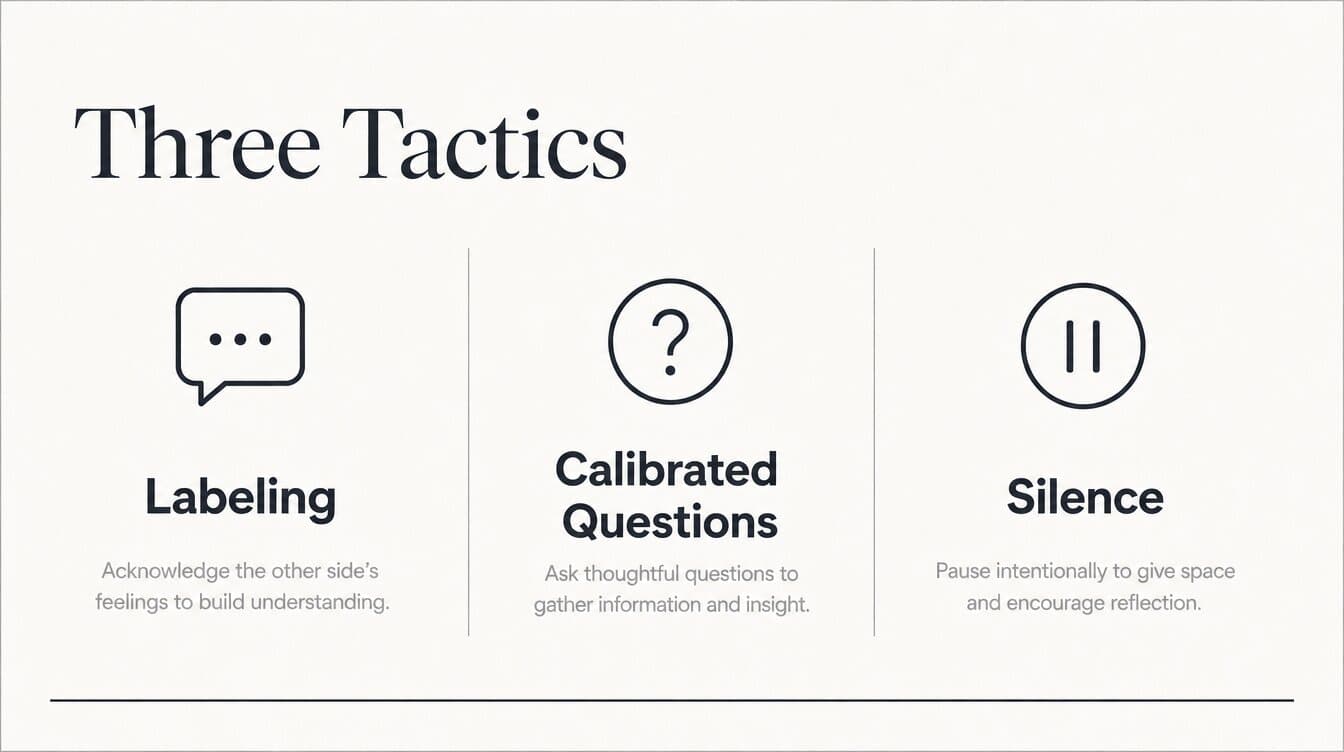
- Labeling. Put the other side's feeling or concern into words: "It sounds like the budget is tight this quarter." Naming a concern out loud tends to defuse it, and it signals that you're paying attention to their reality, not just pushing your own.
- Calibrated questions. Instead of demanding, ask a question that makes the other person solve your problem: "How am I supposed to make that work?" It's not confrontational, but it hands them the constraint and invites them to help.
- Silence. After you make an ask, stop talking. Most people rush to fill the gap, often by negotiating against themselves. Letting a pause sit is one of the most underused moves there is.
"Go to the balcony" — step back mentally and observe the interaction instead of reacting inside it. — William Ury, Getting Past No
The whole approach behind these tactics — and where hostage negotiation and a salary conversation overlap more than you'd expect — is covered in what hostage negotiators can teach us about the psychology of negotiation.
What are the most common negotiation mistakes?
The most common mistake is simple: not negotiating at all — accepting the first offer because pushing back feels awkward. Everything else is a distant second, and the cost of this one compounds over an entire career, because a salary you didn't negotiate becomes the base every future raise is calculated from.
- Talking first about what you'll accept. Revealing your bottom line early hands the other side a gift and caps your upside for free.
- Treating it as a single number. Fixating on salary alone and ignoring everything else that's negotiable — bonus, title, flexibility, timing — leaves value on the table that was there for the asking.
- Making it personal. Turning a disagreement about terms into a fight about character guarantees resentment and usually a worse deal.
- Negotiating without a BATNA. Walking in without knowing your alternative means bluffing, and skilled counterparts can feel a bluff.
- Apologizing for asking. Softening a reasonable request with "sorry to even bring this up" tells the other side the request isn't serious. It's fine to be warm; it's costly to be apologetic.
A deeper look at the errors that quietly drain the most money — and the small fixes for each — lives in the salary negotiation mistakes that cost you thousands. Many of these are also the difference-makers when you're negotiating a raise without feeling awkward, where the relationship with your counterpart is ongoing and the personal-versus-problem distinction matters most.
Does the situation change the strategy?
Yes — the fundamentals stay constant, but how you apply them shifts depending on what you're negotiating and how much leverage you're holding. The four principles and your BATNA travel everywhere; the specific script changes with the situation.
Negotiating a brand-new job offer is the highest-leverage moment you'll get, because the company has already chosen you and switching costs are real — so the questions you ask before saying yes matter enormously, which is the whole subject of what to say before you accept a job offer. Asking for more after an offer is already in hand is a narrower, more delicate move with its own timing, covered in how to ask for a higher salary after you already got an offer.
Negotiating without any external leverage — no competing offer, no obvious alternative — feels impossible but usually isn't, because leverage also comes from value delivered and objective market data; how to negotiate pay without a competing offer works through exactly that. And negotiating a promotion is less about a single conversation and more about timing and framing over months, which the timing and wording that actually work for promotions lays out step by step.
There's also a well-documented pattern worth naming: on average, women are socialized to negotiate less often and are sometimes penalized more when they do — a gap Deepak Malhotra and other researchers have studied closely. That's not a reason to negotiate less; it's a reason to prepare differently, which salary negotiation for women and the confidence gap that isn't really about confidence addresses directly.
How do you prepare for a negotiation?
Preparation is where negotiations are actually won, long before anyone sits down, and it's the part most people skip entirely. If you do only one thing differently after reading this article, make it this: never walk into a negotiation that matters without preparing first.
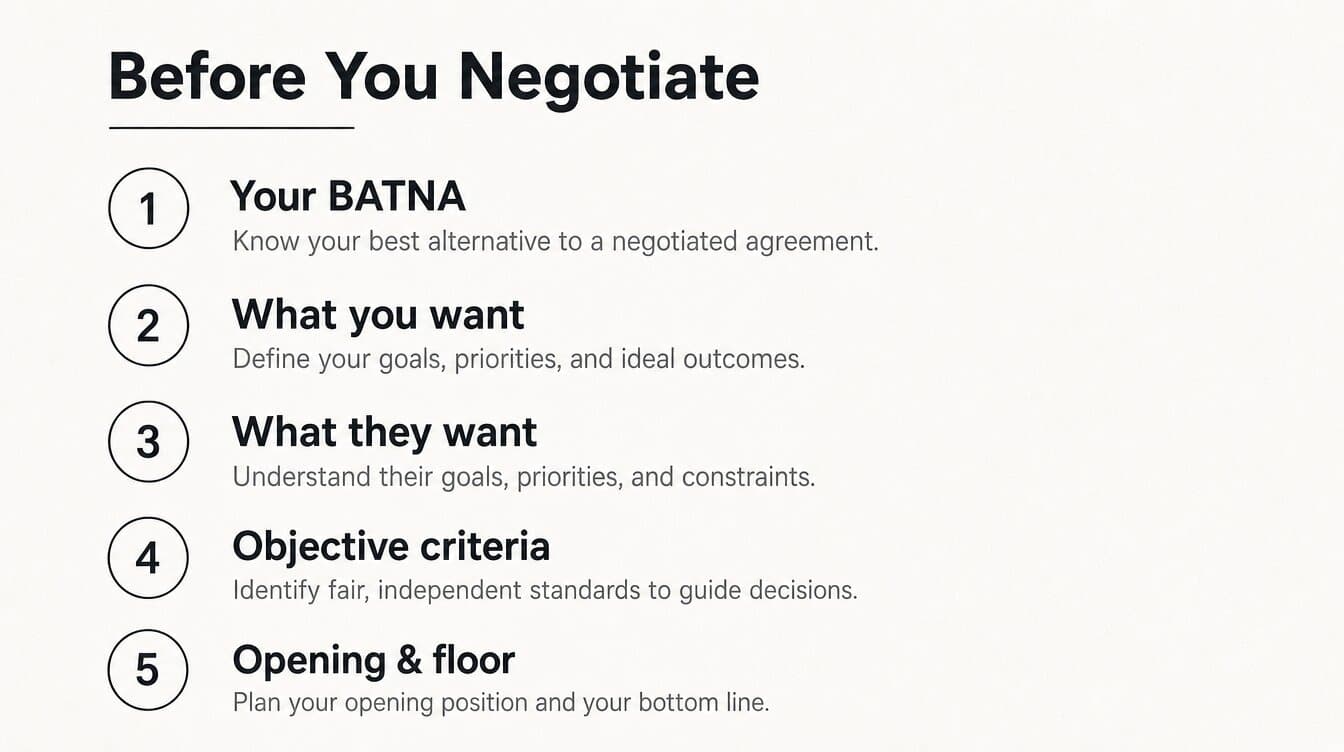
Good preparation answers a short list of questions before the conversation:
- What's my BATNA, honestly? Not the alternative you wish you had — the one you actually have. Line up real options where you can, so your walk-away is a fact, not a bluff.
- What do I actually want, and why? Separate your position (the number) from your interests (the reasons). Knowing your interests tells you what you can trade and what you can't.
- What does the other side want, and why? Their constraints are your map. A manager who can't move on base salary might have full freedom over a signing bonus or a title. You can't find those openings if you haven't thought about their side.
- What objective criteria support my case? Gather the market data, the comparable examples, the documented results. Walking in with "here's what this role pays elsewhere" is a different conversation than "I'd like more."
- What's my opening, and what's my floor? Decide your first ask and your walk-away number in advance, in a calm moment, so you're not improvising under pressure.
The people who seem effortlessly good at this have usually just answered these five questions before every important conversation until it became automatic. There's nothing mystical in it. It's a checklist, run consistently.
The five questions, run against your next real negotiation
Ticked: 0 of 5
Five ticks is a prepared negotiation and two is an improvised one. The gap is an evening of work, not a personality.
Can you get better at negotiating if it doesn't come naturally?
Yes, and this is the most important thing in the article. Negotiation is a skill, which means it responds to practice the same way any skill does — and the people who look "naturally good" at it are almost always people who've simply done it more.
The reason it feels innate in others is that the work is invisible. You see someone stay calm and ask for more, and you don't see the preparation, the alternatives they lined up, or the hundred smaller conversations that got them comfortable. What looks like a personality trait is usually an accumulated habit.
Getting better comes down to a few unglamorous things. Prepare before every negotiation that matters — know your BATNA, know your interests, know the objective criteria. Practice the specific words in low-stakes situations first, so the high-stakes ones aren't your first attempt. Get comfortable with silence and with the discomfort of asking, because tolerance for that discomfort is itself trainable. And treat each negotiation as a rep, not a verdict — one awkward salary conversation isn't proof you're bad at this, it's the first of many that get easier.

What to do next
The thing that speeds this up more than anything is rehearsing on realistic situations before you're in them for real, which is exactly what structured practice is for. What looks like natural talent is almost always just accumulated reps — and reps are something you can start collecting today.
Test yourself
Question 1 of 3
Halfway through a salary call you say: honestly, anything above 60,000 works for me. According to the article, what have you just done?
What are negotiation skills, exactly?
The abilities that let two or more people with different wants reach an agreement that leaves everyone better off than no deal. Not smooth talk or a willingness to bully — a structured conversation about how to divide something or solve a problem together. They break into learnable pieces: preparing, understanding the other side, knowing your alternatives, listening, and knowing when to walk.
What is BATNA and why does it matter?
BATNA is your Best Alternative To a Negotiated Agreement — what you'll do if this deal falls through. It matters more than confidence because it's true regardless of how you feel. A strong alternative sets the floor for what you should accept and lets you walk away for real, which is the actual source of leverage.
What are the four core principles of negotiation?
From the Harvard team: separate the people from the problem, focus on interests rather than positions, invent options for mutual gain, and insist on objective criteria. The through-line is arguing about the problem, not about who's a better person.
How do you negotiate without being aggressive?
Listen more than you talk, name the other side's concerns before they have to, and ask questions instead of making demands. Aggression signals weak technique, not strong. Tactical empathy — accurately naming the other person's perspective — lowers their defensiveness, and a defensive person never makes concessions.
Can you get better at negotiating if it doesn't come naturally?
Yes — it's a skill, not a trait, and it responds to practice like any skill. People who look 'naturally good' have usually just done it more. Prepare before every negotiation, practice the words in low-stakes situations first, get comfortable with silence, and treat each negotiation as a rep rather than a verdict.