As a Man Thinketh
James Allen · 1903
4.8 · 6 ratings
About the book
Fifty pages that set off a century of self-help: character is thought made visible, and circumstance grows out of it the way a plant grows out of a seed. Allen wrote it in a cottage with almost nothing, which is either the argument against him or the entire point.
Try the short course
Part 1 · One sentence the whole book unpacks. The first six slides, free.


1 / 6
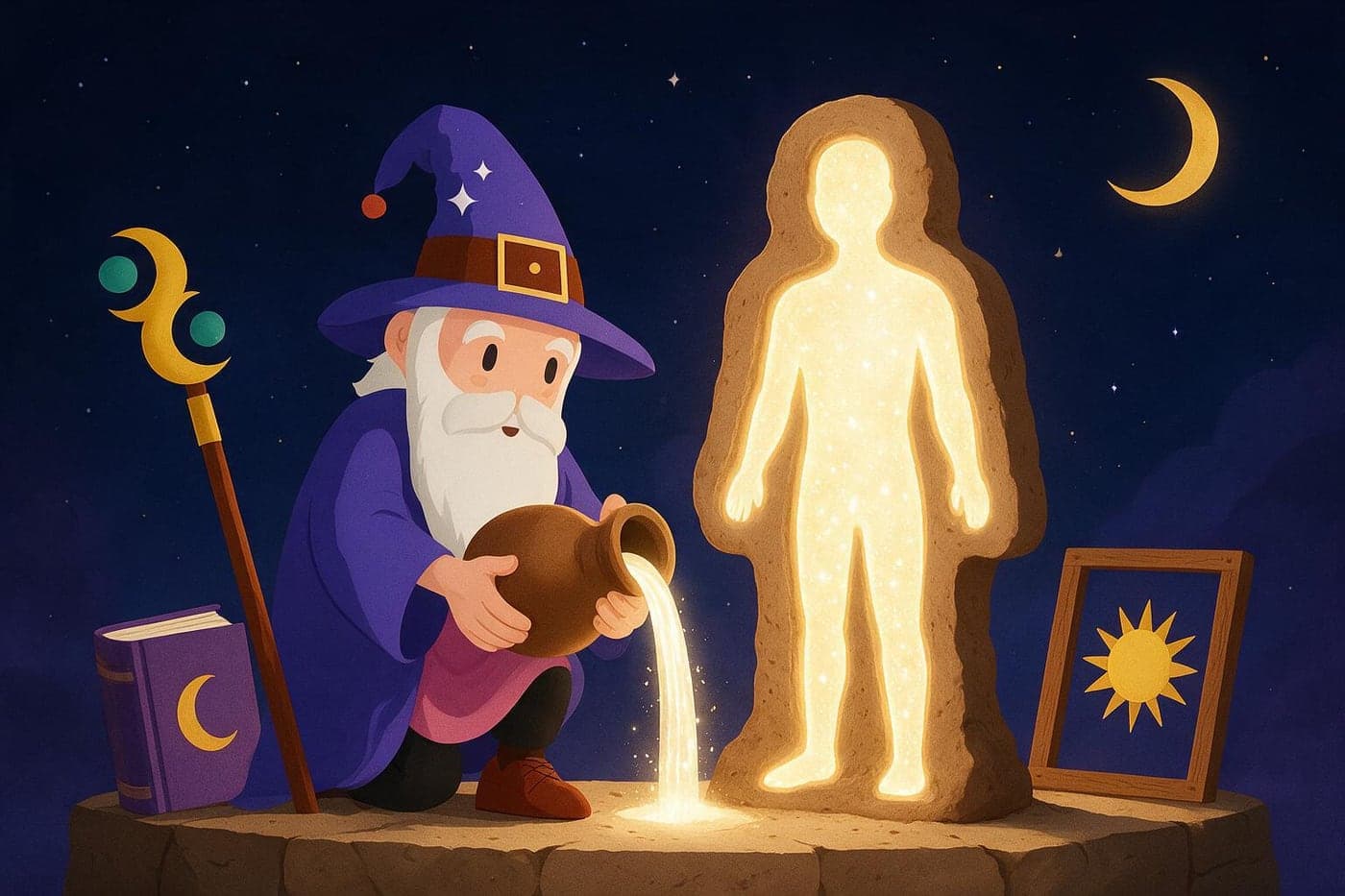
James Allen builds his whole book on one line from the Book of Proverbs: "As a man thinketh in his heart so is he." Most people hear it as a pleasant saying about attitude. Allen reads it as a plain statement of fact.
He says the sentence covers the whole of a person's being, and then he pushes it as far as it will go. A man is literally what he thinks. Not influenced by his thoughts, not coloured by them, but made of them.
Every later chapter, on circumstance, health, purpose and calm, is this one sentence followed a little further out. So it is worth sitting with how strong the claim is before anything else, because the rest of the book only works if you let it be that strong.
Read this preview as text
James Allen builds his whole book on one line from the Book of Proverbs: "As a man thinketh in his heart so is he." Most people hear it as a pleasant saying about attitude. Allen reads it as a plain statement of fact.
He says the sentence covers the whole of a person's being, and then he pushes it as far as it will go. A man is literally what he thinks. Not influenced by his thoughts, not coloured by them, but made of them.
Every later chapter, on circumstance, health, purpose and calm, is this one sentence followed a little further out. So it is worth sitting with how strong the claim is before anything else, because the rest of the book only works if you let it be that strong.
Allen's next line is the one to underline: character is "the complete sum of all his thoughts."
Notice the word sum. It is not the thoughts you would say out loud, and not the ones you are proud of. It includes the argument you replay in the shower, the flicker of envy at a friend's good news, the small contempt for the person who is slow at the till. All of it goes into the same total.
That is why the proverb says "in his heart." Allen is not interested in the opinions a person holds for show. He means what you actually dwell on when nobody is asking, and he claims that this, added up over years, is exactly who you are.
When Allen calls character "the complete sum of all his thoughts," which thoughts is he counting?
- All of them, including the private ones nobody else hearsCorrect answer
- Only the beliefs a person has consciously decided to hold
- The ideals a person aims at, rather than passing moods
- Mostly the ones a person expresses in words or actions
The key word is sum: Allen counts everything a person actually thinks "in his heart," chosen or not, spoken or not, admirable or not. Narrowing it to deliberate beliefs or noble ideals is the comfortable version he never offers.
You snap at someone you love, and afterwards you say it came out of nowhere. Allen's answer is that nothing comes out of nowhere.
His image is the plant, which could not exist without its seed: "every act of a man springs from the hidden seeds of thought." Then he closes the obvious escape route. This holds, he says, just as much for acts called "spontaneous" and "unpremeditated" as for the ones planned in advance.
That is a harder claim than it first looks. The outburst was not the beginning. It was only the first moment the thought became visible, after weeks of being muttered inwardly. The surprise belongs to the person who was not watching what was growing.
Allen carries the image one step further in a single sentence: "Act is the blossom of thought, and joy and suffering are its fruits."
Read it as a sequence. A thought is held. Held long enough, it opens into an act. The act ripens into how life actually tastes, sweet or bitter. He calls the whole process a person's own husbandry, the old word for farming, and the point is that you gather what you farmed, not what somebody else planted for you.
This is where readers get defensive, because it sounds like blame. It is closer to agriculture than to a courtroom. A farmer is not being punished by a thin harvest. The harvest is simply the report on what was sown and tended, arriving later, when there is no arguing with it.
Allen makes one exception: acts done on impulse, without any forethought, do not grow out of a person's thoughts.
FalseCorrect answer
He names that exception only to reject it. Acts called "spontaneous" and "unpremeditated" spring from the hidden seeds of thought just as surely as deliberate ones; the impulse is simply the moment an old thought breaks the surface.
Inside the course
10 parts- «As a man thinketh»: the sentence the whole book unpacksFree above
- Character as thought, hardened into habit
- The garden, and what Allen means by weeding it
- Circumstance: what your life keeps arranging around you
Questions
Is As a Man Thinketh free to read in Astra Trainer?
Yes. The full book opens free in the app’s reader, in English, Spanish, German, French, Italian, Polish, Portuguese, and Russian.
What is the short course?
10 short parts that walk through the book’s key ideas in slides, each with a quick quiz. The first six slides are free to try on this page.
Where do I get the app?
Astra Trainer is free on the App Store and Google Play. As a Man Thinketh is waiting in the app’s library.