The Pictorial Key to the Tarot
A. E. Waite · 1911
5.0 · 5 ratings
About the book
The book standing behind the deck almost everyone learns on — Waite explaining, card by card, what he had Pamela Colman Smith draw. He is secretive, prickly and occasionally rude about rival tarotists, and this is still the source.
Try the short course
Part 1 · Why Waite Picked a Fight. The first six slides, free.


1 / 6
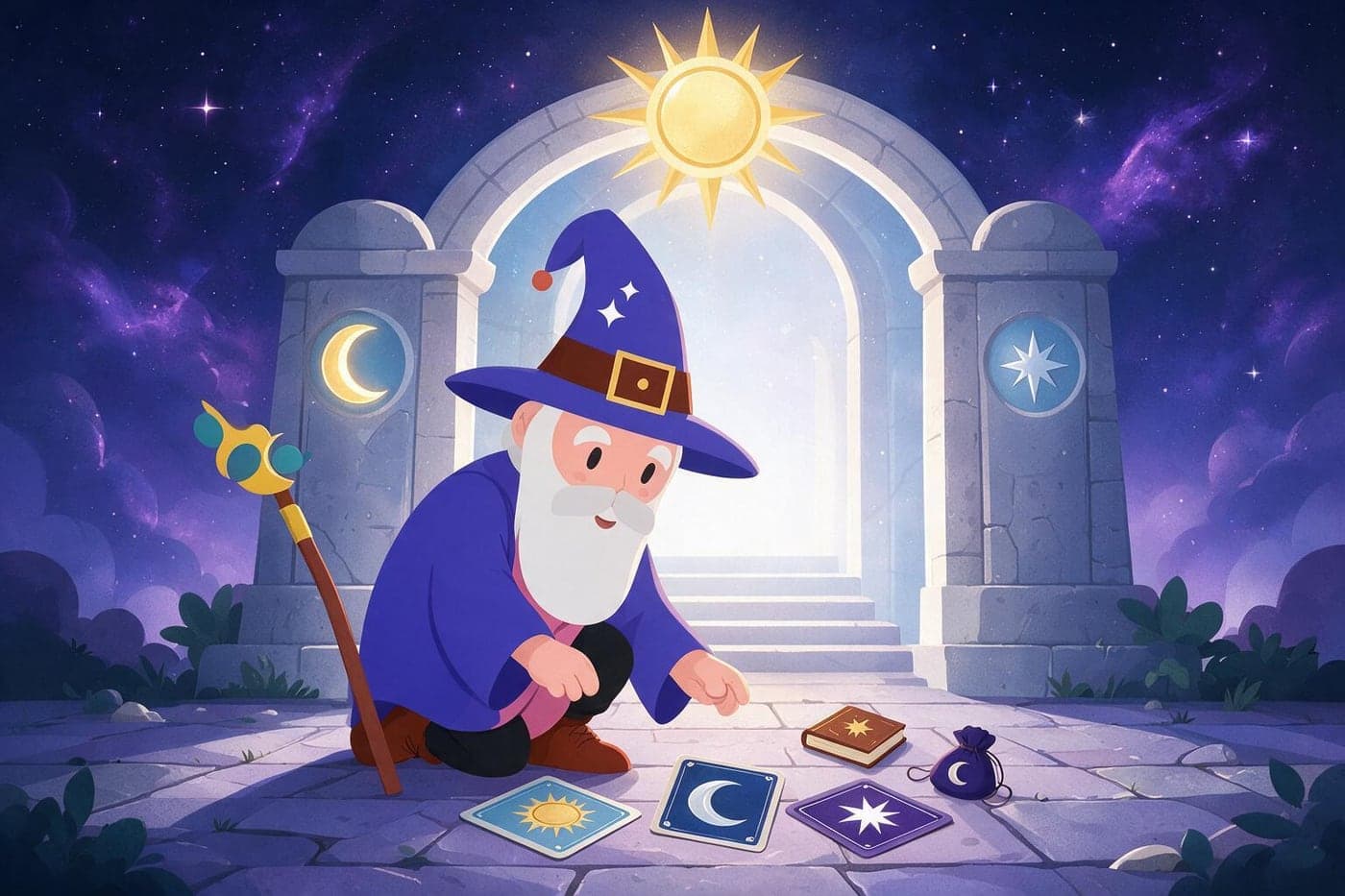
Waite opens defensively because Tarot looks like an embarrassing subject for a serious mystic: a familiar instrument of fortune-telling. He expects readers to wonder why someone concerned with “the higher mystic schools” would touch it at all.
His answer is deliberately paradoxical. Humble work may stand near the entrance to wisdom, just as an initiate might serve as a door-keeper. Tarot’s common use does not settle its value. Lowly use can conceal higher symbolism-but lowliness alone proves nothing sacred.
Read this preview as text
Waite opens defensively because Tarot looks like an embarrassing subject for a serious mystic: a familiar instrument of fortune-telling. He expects readers to wonder why someone concerned with “the higher mystic schools” would touch it at all.
His answer is deliberately paradoxical. Humble work may stand near the entrance to wisdom, just as an initiate might serve as a door-keeper. Tarot’s common use does not settle its value. Lowly use can conceal higher symbolism—but lowliness alone proves nothing sacred.
Waite places the cards “at the outermost gates,” among the debris of the occult arts. That is not praise for everything called occult. He insists that much surrounding Tarot is foolish, commercial or intellectually careless.
Yet the cards themselves, he says, “belong in themselves to another region.” Their familiar setting and their symbolic content must therefore be judged separately. The surroundings are not the substance: bad practitioners do not automatically make the images empty, and mysterious claims do not automatically make them wise.
Why does Waite defend writing about Tarot despite its reputation as fortune-telling?
- Its commercial success gives it philosophical importance.
- Its popularity proves that its historical legends are correct.
- Its predictions provide scientific evidence for occult doctrine.
- Its humble reputation may hide a higher symbolic content.Correct answer
Waite separates Tarot’s disreputable surroundings from what he considers its higher symbolism. Popularity, profit and predictive claims do not supply his justification.
The proposed rescue has two targets. First, Tarot has become the “stock-in-trade” of cartomancists: a professional tool reduced to practical answers about love, money, journeys and rivals. Second, its history and interpretation have been handled by writers whose claims cannot survive serious attention to evidence.
These failures differ. One reduces Tarot to tradecraft; the other inflates it with unsupported antiquity and secret pedigrees. Waite refuses both the cheapening and the grandiose embellishment.
Earlier occult writers had connected Tarot with ancient Egypt, the Book of Thoth, hidden priesthoods and other impressive origins. Waite subjects such stories to historical criticism rather than accepting them because they sound initiatory.
For him, an old-looking emblem is not proof of an ancient lineage. Nor does repetition turn speculation into tradition. His quarrel is with writers who substitute resemblance, assertion or romance for evidence. Symbolic depth needs no invented pedigree: Tarot can matter even if its most glamorous origin stories collapse.
Waite concludes that false histories make Tarot’s symbolism worthless.
FalseCorrect answer
He separates the historical question from the symbolic one. Invented antiquity must be rejected, but the cards may still contain what he calls “a very high symbolism.”
Inside the course
12 parts- Waite's quarrel with the fortune-tellers who came before himFree above
- The Fool and the Magician: the two cards everything starts from
- The early trumps, and the education of the Fool
- Strength, the Hermit, the Wheel — the middle of the journey
Questions
Is The Pictorial Key to the Tarot free to read in Astra Trainer?
Yes. The full book opens free in the app’s reader, in English, Spanish, German, French, Italian, Polish, Portuguese, and Russian.
What is the short course?
12 short parts that walk through the book’s key ideas in slides, each with a quick quiz. The first six slides are free to try on this page.
Where do I get the app?
Astra Trainer is free on the App Store and Google Play. The Pictorial Key to the Tarot is waiting in the app’s library.