The Tarot of the Bohemians
Papus · 1892
5.0 · 5 ratings
About the book
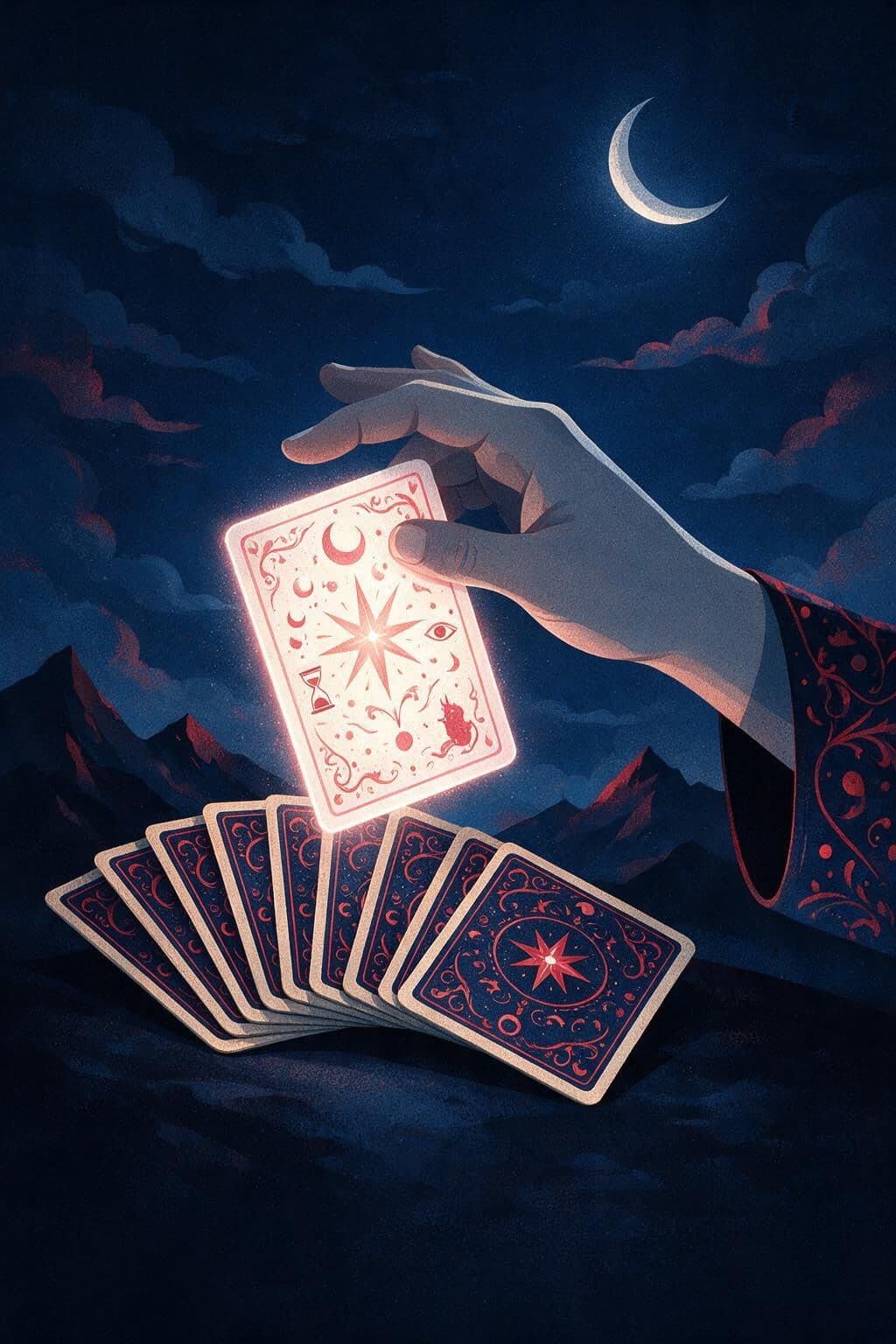
Papus treats the tarot as a machine: seventy-eight cards fitting together by number, letter and element into a single working diagram of everything. Dense, mathematical, and the book that convinced Europe the deck was coded philosophy.
Try the short course
Part 1 · A machine, not a picture book. The first six slides, free.

1 / 6
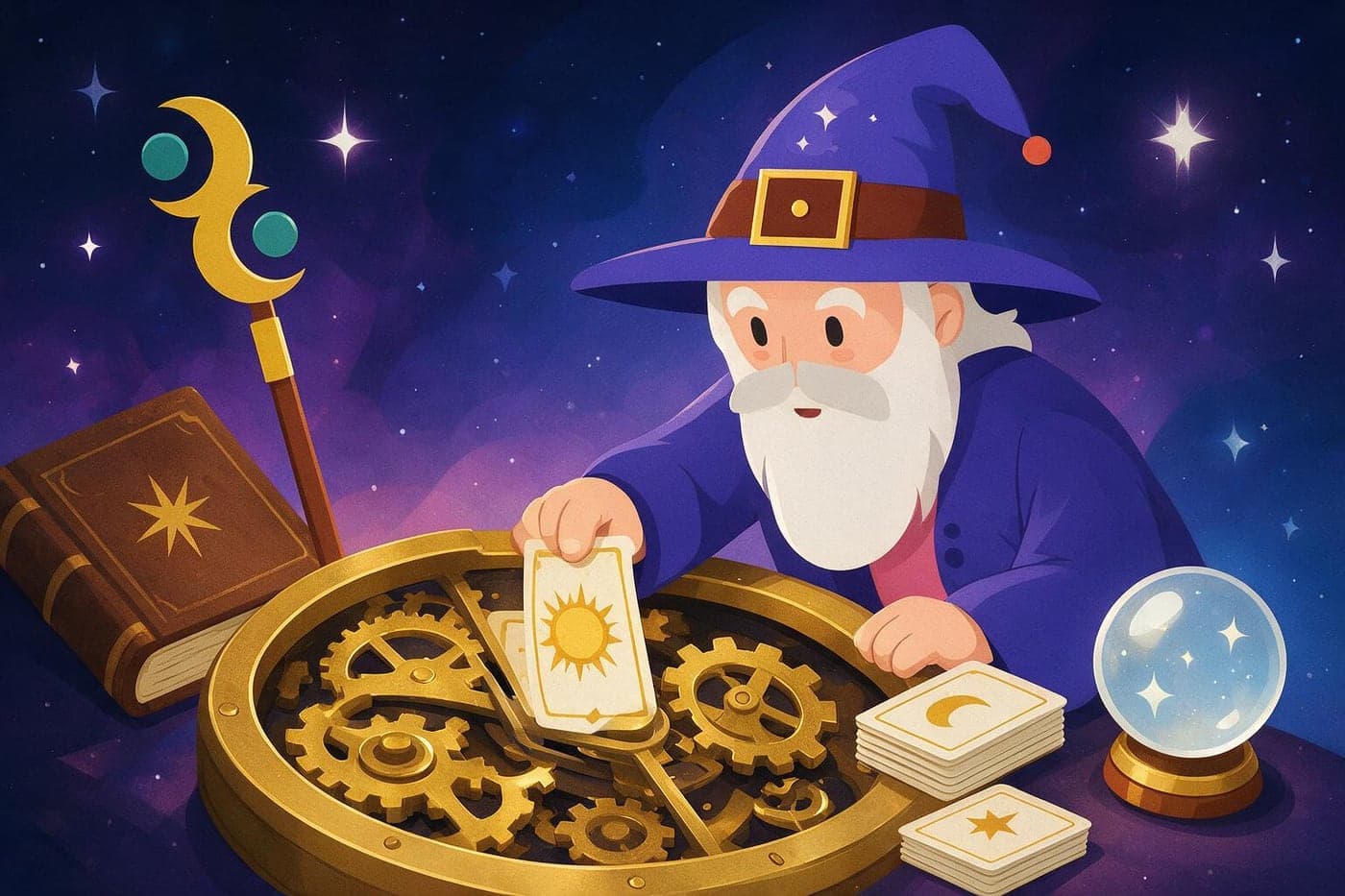
Most people meet the tarot as a set of pictures. You turn a card, look at the figure on it, and ask what it stirs in you. The deck works like an album, and every card is a small painting to be read by feel.
Papus starts somewhere else entirely. He promises to study "each of the pieces which compose our machine," and then the way those pieces act on one another. That is an engineer talking, not a fortune-teller.
So the question he cares about is not what a card looks like. It is why there are seventy-eight of them, why they fall into these groups, and what holds each one in place. What he offers is a construction key, not a dictionary of meanings. The meanings do come, but later, and they come out of the construction.
Read this preview as text
Most people meet the tarot as a set of pictures. You turn a card, look at the figure on it, and ask what it stirs in you. The deck works like an album, and every card is a small painting to be read by feel.
Papus starts somewhere else entirely. He promises to study "each of the pieces which compose our machine," and then the way those pieces act on one another. That is an engineer talking, not a fortune-teller.
So the question he cares about is not what a card looks like. It is why there are seventy-eight of them, why they fall into these groups, and what holds each one in place. What he offers is a construction key, not a dictionary of meanings. The meanings do come, but later, and they come out of the construction.
He opens not with cards but with a complaint about knowledge itself. Science, he says, has pushed analysis as far as it will go, cutting every subject into narrower specialisms, and all it has done is deepen "the moats which divide the sciences."
His remedy is synthesis: a way of holding knowledge together instead of taking it apart. He believed the ancient temple schools had it, and that their whole teaching was condensed into a few very simple laws.
This is why the deck matters so much to him. He is not looking for a sharper way to predict next week. He is looking for the lost synthesis, and the tarot is where he claims to have found it still in one piece.
What problem does Papus set out to solve before he says a word about the cards?
- Materialist science has declared every symbol meaningless
- Fortune-tellers have corrupted the true meanings of the cards
- The pictures on modern decks have drifted from the originals
- Analysis has split knowledge apart, and a synthesis is neededCorrect answer
His opening complaint is about method: analysis has only deepened the moats between the sciences, so something must hold knowledge together again. Changing pictures and careless fortune-tellers do come up in the book, but they are not where he starts.
If the ancients had a synthesis, where did it go? Papus answers that its keepers, seeing it could be lost, sent it down three roads at once.
The first road was the secret societies, which carried on the old mysteries. The second was religion, which translated the teaching into rites a whole nation could follow. The third was the people themselves, who would carry it without knowing what they carried.
Two of the three roads, in his telling, lost the thread. Freemasonry kept its ceremonies but forgot what its symbols meant. The religions hardened into rival creeds and lost sight of the unity of all creeds beneath them. Only the third road delivered the teaching whole, and it is the one nobody would have bet on.
The people Papus names are the Bohemians, the Romani, and what they carried was a pack of cards. It earned them a living through fortune-telling and passed the evenings as a gambling game. Nobody treated it as sacred, and that, he argues, is exactly what saved it.
A people that understands none of what it holds, he says, takes care never to alter it. A scholar would have improved the deck; a priest would have reinterpreted it. A card game simply gets played, generation after generation, and the structure survives untouched while its meaning sleeps inside.
Hence his boldest claim: this ordinary deck is the Bible of Bibles, the book of Thoth. Hold that as his premise. Whether the history is true is a separate question from whether the structure works.
Papus argues that the tarot survived intact precisely because the people who carried it did not understand it.
TrueCorrect answer
That is his claim, stated flatly: a people that grasped none of the truths it held was careful never to change them. Freemasons and priests understood more, and in his account that is exactly how they lost their keys.
Inside the course
12 parts- The tarot as a machine rather than a picture bookFree above
- Yod-He-Vau-He, the four-letter key Papus builds on
- The Hebrew alphabet laid over twenty-two cards
- The Magician, the High Priestess and the first septenary
Questions
Is The Tarot of the Bohemians free to read in Astra Trainer?
Yes. The full book opens free in the app’s reader, in English, Spanish, German, French, Italian, Polish, Portuguese, and Russian.
What is the short course?
12 short parts that walk through the book’s key ideas in slides, each with a quick quiz. The first six slides are free to try on this page.
Where do I get the app?
Astra Trainer is free on the App Store and Google Play. The Tarot of the Bohemians is waiting in the app’s library.