


It sounds like a strange comparison at first. A hostage standoff and a conversation about your salary don't seem to belong in the same sentence. But strip away the stakes and both situations share the same underlying structure: you're talking to someone who doesn't fully trust you yet, under real pressure, where the wrong move can shut the conversation down entirely. The tactics built for the extreme version of that problem turn out to work just as well, often better, in the ordinary version.
Negotiation Skills 101 touched on this briefly through the work of Chris Voss, a former lead FBI hostage negotiator whose book Never Split the Difference reframed empathy as a tactic rather than a soft skill. This article unpacks his core techniques in full, with the actual phrasing to use in a career conversation. If you want to see these same techniques already built into a complete salary conversation, a full negotiation script puts several of them to work end to end.
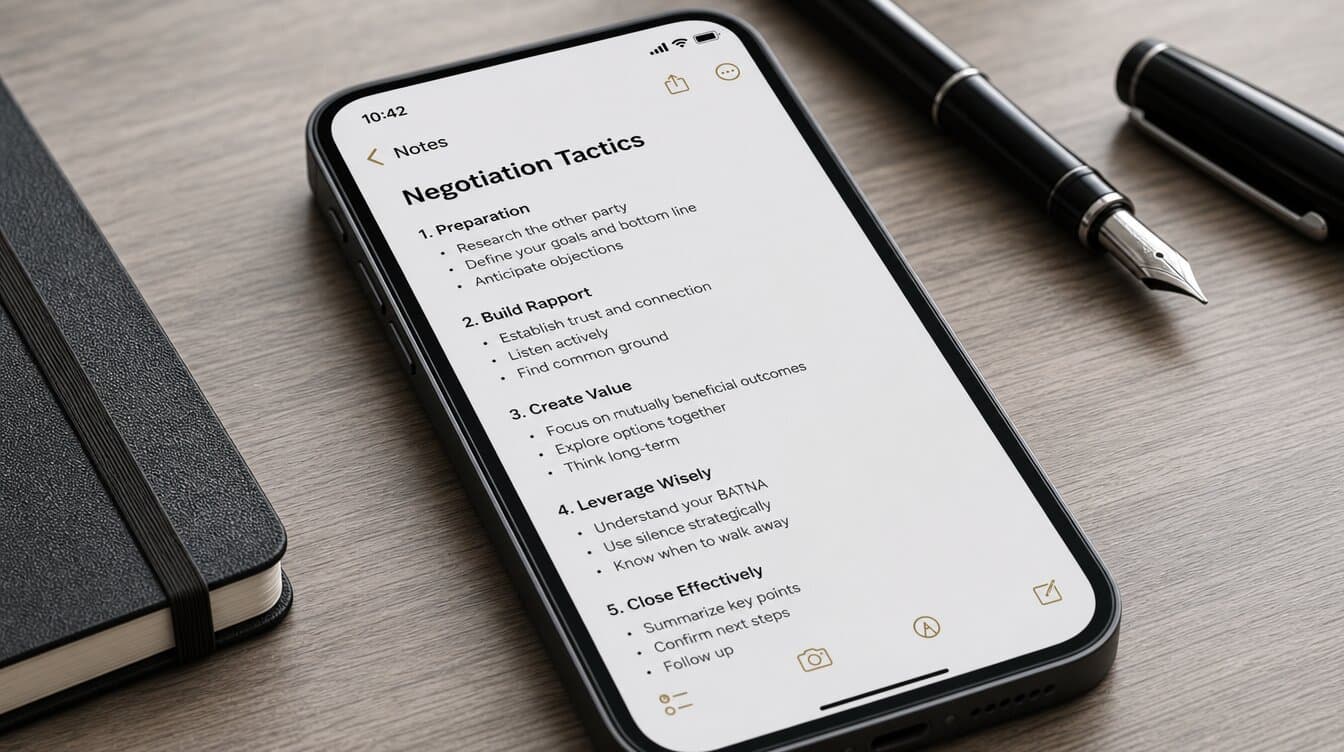
What can hostage negotiation actually teach us about a salary conversation?
Both situations are, at their core, about getting a nervous, defensive person to feel heard enough that they stop protecting their position and start actually engaging with yours. A hostage negotiator can't force an outcome through pressure — pressure escalates a crisis. Neither can you, across a desk, force your manager to agree through sheer insistence. In both cases, the actual lever is trust, built quickly, through specific and repeatable techniques rather than charisma or luck.
Negotiation isn't a battle of wills, it's an exercise in making the other person feel safe enough to say yes.
Voss built his entire approach around that idea, because in hostage situations, threats and ultimatums almost never work — the person on the other end has to feel understood before they'll move at all. A salary conversation runs on the exact same psychology, just with far lower stakes and far more room for error.
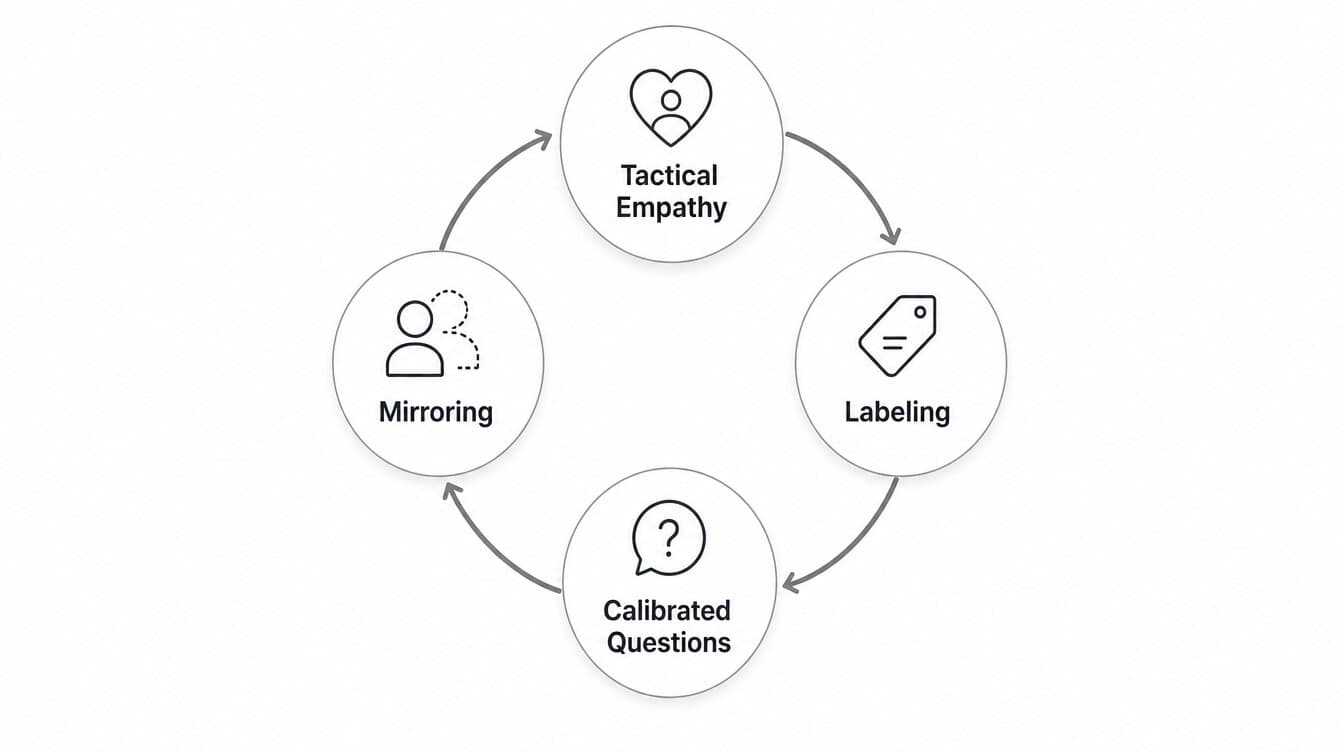
What is tactical empathy, and how is it different from just being nice?
Tactical empathy means understanding the other person's perspective well enough to name it accurately — not to agree with it, and not to be agreeable, but because naming someone's position out loud lowers their defensiveness enough that they can actually hear you.
This is different from ordinary niceness in an important way. Being nice often means avoiding friction — smiling past a hard topic, softening every request until it barely registers as a request at all. Tactical empathy does the opposite: it goes directly at the tension in the room and names it. If your manager seems hesitant about your raise request, ordinary niceness might avoid mentioning that hesitation at all.
"It seems like this request might be catching you off guard — is there something specific making it hard to say yes right now?"
That distinction matters because avoided tension doesn't disappear — it just goes unaddressed and quietly shapes the rest of the conversation. Naming it, calmly and without accusation, tends to shrink it, because most people relax slightly once they realize their hesitation has actually been noticed rather than ignored.
Empathy here isn't about being liked. It's a tool for lowering the other person's guard enough that the real conversation can start.
What is the labeling technique, and how do you use it?
Labeling means putting the other person's likely emotion or position into words, usually starting with "It sounds like…" or "It seems like…" — a technique Voss used constantly in hostage negotiations because naming a feeling out loud tends to defuse it, while ignoring it tends to let it grow.
The mechanism is straightforward: most people don't feel fully heard, and an unacknowledged emotion keeps pulling attention away from the actual conversation. Once it's named accurately, it stops needing to be proven, and the person can move on to the substance.
In a career context, this might sound like:
"It sounds like budget is genuinely tight this quarter, not just a soft no."
Or, if you sense resistance without an obvious reason:
"It seems like there's more to this than just the number — is there a constraint I'm not seeing?"
Notice that labels are phrased as observations, not accusations. "It sounds like…" invites correction if you're wrong, which makes it low-risk to try even when you're not fully sure.
What are calibrated questions, and why do they work better than direct demands?
Calibrated questions are open-ended questions, usually starting with "How" or "What," that hand your problem to the other person to solve, rather than stating a demand they either accept or reject. Voss favored these because a direct demand invites a yes-or-no reaction, often defensive, while an open question invites collaboration.
The classic example, adapted for a raise conversation: instead of saying "I need a 10% increase," you ask:
"How can we get my compensation to reflect what I've taken on this year?"
The demand version gives your counterpart exactly one decision to make — approve or reject you. The question version gives them a problem to help solve, which tends to produce more creative, less defensive answers, and often surfaces flexibility a flat demand would never have uncovered.
Another useful calibrated question for handling pushback:
"What would need to be true for this to work on your end?"
This doesn't concede anything, and it doesn't demand anything either — it simply asks the other person to define the actual constraint, which is usually more specific and more workable than the vague "no" that came before it.
"How am I supposed to do that?" — said with genuine curiosity rather than frustration — puts the problem back in the other person's hands without any hint of confrontation when they hand you an unexpected limitation.
Does mirroring actually work, and how do you use it without it feeling weird?
Yes, and it works better than it sounds like it should. Mirroring means repeating the last few words the other person said, usually as a question, which prompts them to elaborate rather than move on — a simple technique Voss used to draw out more information without ever asking a direct question that might feel like an interrogation.
Done well, it's nearly invisible. If your manager says, "We're really watching the budget this quarter," a mirror sounds like:
"Watching the budget this quarter?"
Said with genuine curiosity, not sarcasm. More often than not, the other person keeps talking, filling in the detail your original question might never have drawn out directly: which specific budget line, whose decision it actually is, whether it's a hard constraint or a soft one.
The trick to avoiding the "weird" feeling is restraint — mirror occasionally, not every sentence, and keep your tone genuinely curious rather than performative. Overused, it starts to sound like an interview technique. Used sparingly, at the right moment, it barely registers as a technique at all.
Mirroring works especially well right after a number or a constraint gets mentioned, since that's usually the moment with the most unspoken detail behind it. A manager who says "that's above what we'd budgeted" and gets a simple, curious "above what you'd budgeted?" in return will often clarify by how much, and why — information you'd have had to ask for directly, and might not have gotten as freely.
Check yourselfYou summarise your manager's position back to them and they answer: you're right. Before you read on: how much has that told you about where the conversation stands?Show the answerHide the answer
Less than it sounds like. Voss treated you're right as the far more common and far less meaningful of the two responses — usually a polite way of moving past a point rather than confirming it. The signal worth aiming your labels and summaries at is that's right, especially with elaboration attached, because it means the other person feels you have actually grasped their situation rather than talked at it.
What's the difference between "That's right" and "You're right"?
"That's right" signals genuine understanding — the other person feels you've actually grasped their situation. "You're right" usually signals the opposite: a polite way of ending the conversation without real agreement, often said just to move past a point rather than to confirm it. Voss treated hearing "that's right" as one of the clearest signs that a negotiation was actually progressing, distinct from the far more common and far less meaningful "you're right."
If your manager responds with a flat 'you're right, anyway…', that's often a sign they're moving past the topic, not that you've landed on real shared understanding. 'That's right, exactly' — with elaboration — is the signal real movement is close.
You can use this as a diagnostic in your own conversations. Aim your own labels and summaries at earning a "that's right." A useful test question after summarizing their position:
"Is that a fair read of where things stand?"
Phrased to invite genuine confirmation rather than a quick brush-off.
Count the ones that are already how you talk at work
Ticked: 0 of 5
A low count is the expected one. The article's own advice is to add a single technique at a time, not all five at once.
What to do next
None of these techniques require you to be someone you're not, and none of them are manipulative in the way they might sound at first — they're built around getting to a genuinely honest, well-understood agreement faster, not tricking anyone into one. Try one technique at a time rather than all five at once. Labeling is usually the easiest place to start, because it costs nothing to try and rarely backfires even when your read is slightly off.
Test yourself
Question 1 of 3
You want a ten percent increase. What does asking how your compensation could reflect what you have taken on do that stating the number does not?
What can hostage negotiation teach us about a salary conversation?
Both are about getting a nervous, defensive person to feel heard enough to stop protecting their position and start engaging. Neither pressure nor insistence forces an outcome — the actual lever is trust, built through specific, repeatable techniques rather than charisma.
What is tactical empathy?
Understanding the other person's perspective well enough to name it accurately, not to agree with it. Unlike ordinary niceness, which avoids friction, tactical empathy names the tension in the room directly, which tends to shrink it rather than let it grow unaddressed.
What is the labeling technique in negotiation?
Putting the other person's likely emotion or position into words, usually starting with 'It sounds like...' Naming a feeling defuses it because it stops needing to be proven — the person can move on to the substance instead of the unspoken tension.
What are calibrated questions?
Open-ended questions starting with 'How' or 'What' that hand your problem to the other person to solve, rather than a demand they accept or reject. They invite collaboration and often surface flexibility a flat demand would never uncover.
Does mirroring actually work in negotiation?
Yes. Repeating the last few words someone says, with genuine curiosity, prompts them to elaborate without feeling interrogated. It works best right after a number or constraint is mentioned, since that's usually the moment with the most unspoken detail.
What's the difference between 'That's right' and 'You're right'?
'You're right' is often a polite way to end a conversation without real agreement. 'That's right' signals genuine understanding — Voss treated it as one of the clearest signs a negotiation was actually progressing.