Fortune-Telling by Cards
P. R. S. Foli · 1902
5.0 · 3 ratings
About the book
Every parlour method of reading an ordinary deck, collected by «Professor Foli» — in private life the newspaper magnate who founded the Daily Express. Thirty-two-card spreads, the Grand Star, wish cards and the master method, written for the drawing room and none the worse for it.
Try the short course
Part 1 · Where the pack came from. The first six slides, free.


1 / 6
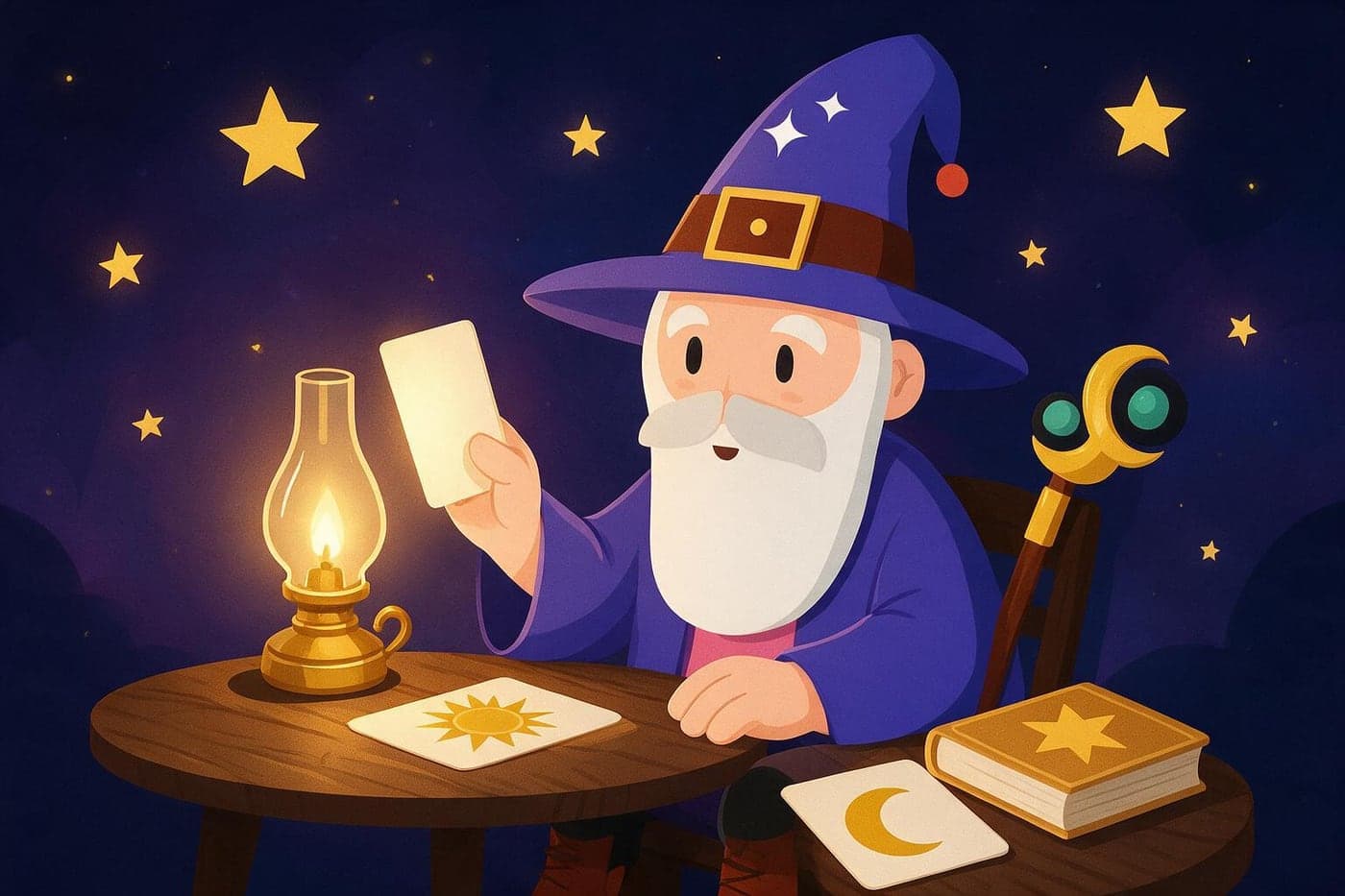
Deal a pack for a rubber of whist or a quiet game of Patience and you are handling what Foli calls “those smooth, highly-glazed playthings”. He asks you to stop for a moment and see what else they are.
The documented history of playing cards, he says, reaches back only about five hundred years. Behind it he places an older story that cannot be traced: India, China and Chaldea had cards of their own, different in design and in use, and their wise men treated them with none of the contempt the West later showed.
To them a card was a medium for the partial revelation of the Unknowable. Keep hold of the word partial. From the first page of his history, Foli's cards reveal a little, never everything.
Read this preview as text
Deal a pack for a rubber of whist or a quiet game of Patience and you are handling what Foli calls “those smooth, highly-glazed playthings”. He asks you to stop for a moment and see what else they are.
The documented history of playing cards, he says, reaches back only about five hundred years. Behind it he places an older story that cannot be traced: India, China and Chaldea had cards of their own, different in design and in use, and their wise men treated them with none of the contempt the West later showed.
To them a card was a medium for the partial revelation of the Unknowable. Keep hold of the word partial. From the first page of his history, Foli's cards reveal a little, never everything.
Foli then passes on a report from a writer of the late fifteenth century: cards were first known in Europe at Viterbo in 1379, brought in by the Saracens, who with the Arabs and Moors are credited with carrying cartomancy into Spain.
The clue he leans on is a name. The earliest cards were called naibi, and the Hebrew and Arabic words nabi and nabaa mean “to foretell”. From this comes a belief he calls widely held: that cards were made for divination, and games were an afterthought.
It turns the usual story around. On this account the gambler borrowed the fortune-teller's tool, not the other way round, and a person laying out a spread is using the pack for its first purpose.
Why does Foli treat the early name naibi as a clue to what cards were first used for?
- It meant a costly painted pack owned by the nobility
- It was the name of the Viterbo house that first sold them
- It echoes Hebrew and Arabic words meaning to foretellCorrect answer
- It was the Saracen word for the twenty-two symbol cards
Foli links naibi to nabi and nabaa, words meaning “to foretell”, and reads the name as a sign that divination came first and play came later. Viterbo and the Saracens appear in the same passage, but only as the place and the people who brought the cards.
In Foli's account the oldest cards were the tarots, symbolic pictures meant for divination. Around the middle of the fourteenth century someone added numeral cards to them so that games could be played.
By the beginning of the fifteenth century Venice had a pack of seventy-eight cards: twenty-two symbols and fifty-six numerals. Each of the four suits held four court cards, king, queen, chevalier and valet, and ten pip cards.
Do the arithmetic and the deck in your drawer appears. The fifty-six numerals became fifty-two when one of the picture cards was rejected from every suit. What you shuffle today is the numeral half of that Venice pack, with its twenty-two symbols set aside and one court figure gone from each suit.
Which picture card went depended on who was holding the pack, and Foli tells it with a smile. The Spaniards “discourteously abolished the queens”. The French, true to their reputation, kept the dame and threw out the chevalier instead.
The early German packs followed the French, until the queens were cast out once more in favour of a superior knave called the Obermann. England, he says, simply took the Spanish or French pack as she found it.
So the king, queen and knave of an English deck are a French decision, not a law of nature. When a queen turns up in a reading, she is a figure who survived because one country refused to give her up.
In Foli's account, the Spaniards kept the queen and dropped the chevalier, while the French were the ones who abolished the queens.
FalseCorrect answer
It was the reverse: the Spaniards abolished the queens, and the French kept the dame and rejected the chevalier. The early Germans later dropped their queens too, in favour of the Obermann.
Inside the course
12 parts- How we got our pack of cardsFree above
- What the individual cards signify
- The selected pack of thirty-two
- Quartettes, triplets and pairs
Questions
Is Fortune-Telling by Cards free to read in Astra Trainer?
Yes. The full book opens free in the app’s reader, in English, Spanish, German, French, Italian, Polish, Portuguese, and Russian.
What is the short course?
12 short parts that walk through the book’s key ideas in slides, each with a quick quiz. The first six slides are free to try on this page.
Where do I get the app?
Astra Trainer is free on the App Store and Google Play. Fortune-Telling by Cards is waiting in the app’s library.