The Kabala of Numbers
Sepharial · 1911
4.8 · 8 ratings
About the book
Sepharial reduces names, dates and planets to numbers and then reads them, up to and including a chapter on picking lottery numbers. Sceptics will enjoy it; numerologists will find most of their system already assembled here.
Try the short course
Part 1 · What Sepharial means by a kabala. The first six slides, free.


1 / 6

Sepharial's title sounds like a promise of Hebrew mysticism, but he uses the word far more loosely. A kabala, in his definition, is anything that hides secret information, and it can take many forms: "literal, numerical, or hieroglyphic".
So a kabala is a key, not a creed. It is a way of tucking meaning inside something ordinary-looking, and of getting it back out if you know the rule. One letter swapped for another is a kabala. So is a name turned into a sum.
That is why the book ranges so freely. Hebrew letter values sit beside Greek ones, Hindu number riddles beside the Tarot and the planets. He is not teaching one tradition. He is collecting working keys and testing which doors they open.
Read this preview as text
Sepharial's title sounds like a promise of Hebrew mysticism, but he uses the word far more loosely. A kabala, in his definition, is anything that hides secret information, and it can take many forms: "literal, numerical, or hieroglyphic".
So a kabala is a key, not a creed. It is a way of tucking meaning inside something ordinary-looking, and of getting it back out if you know the rule. One letter swapped for another is a kabala. So is a name turned into a sum.
That is why the book ranges so freely. Hebrew letter values sit beside Greek ones, Hindu number riddles beside the Tarot and the planets. He is not teaching one tradition. He is collecting working keys and testing which doors they open.
His first real move is almost a joke. Two eggs and two eggs make four eggs, he says, and the sum ignores the small matter that one of them may be bad.
A figure tells you how many. It tells you nothing about what kind. Four eggs can be breakfast or a disaster, and the 4 is exactly the same in both cases. From this Sepharial draws a rule that runs through the whole book: every number is potentially good or evil, and the figure alone will never say which.
This cuts both ways. It means no number is simply lucky or simply cursed. It also means that if a number is going to mean anything at all, the meaning has to come from somewhere other than the figure on the page.
What does Sepharial's example of the four eggs establish?
- Arithmetic becomes unreliable when it is applied to living things
- A figure records quantity, so quality must come from elsewhereCorrect answer
- Even numbers such as 4 tend to bring spoiled or failed outcomes
- The number 4 is fortunate only when all of its parts are sound
The 4 stays a 4 whether the eggs are fresh or rotten: a figure carries quantity and nothing else. That is why he calls every number potentially good or evil instead of branding 4, or even numbers, as unlucky.
So where does the meaning come from? Sepharial answers bluntly at the start of his chapter on numerology: "no claim is made for any occult power or mystic virtue inhering in numbers as such."
If a number has any power, he goes on, it is only because of the ideas the human mind has associated with it. Nine does not glow red by itself. Over centuries it has been linked with Mars, with iron, with the sword, and that web of links is what the kabalist reads.
This is a more modest claim than most people expect from an occult handbook of 1911. Numbers are symbols, not charms. A 9 in your name is not a spark waiting to catch. It is a word in a language.
"Associated ideas" could sound arbitrary, as if anyone might decide tomorrow that 9 means gentleness. Sepharial closes that door. The associations he trusts are the ones fixed by the shapes of nature itself.
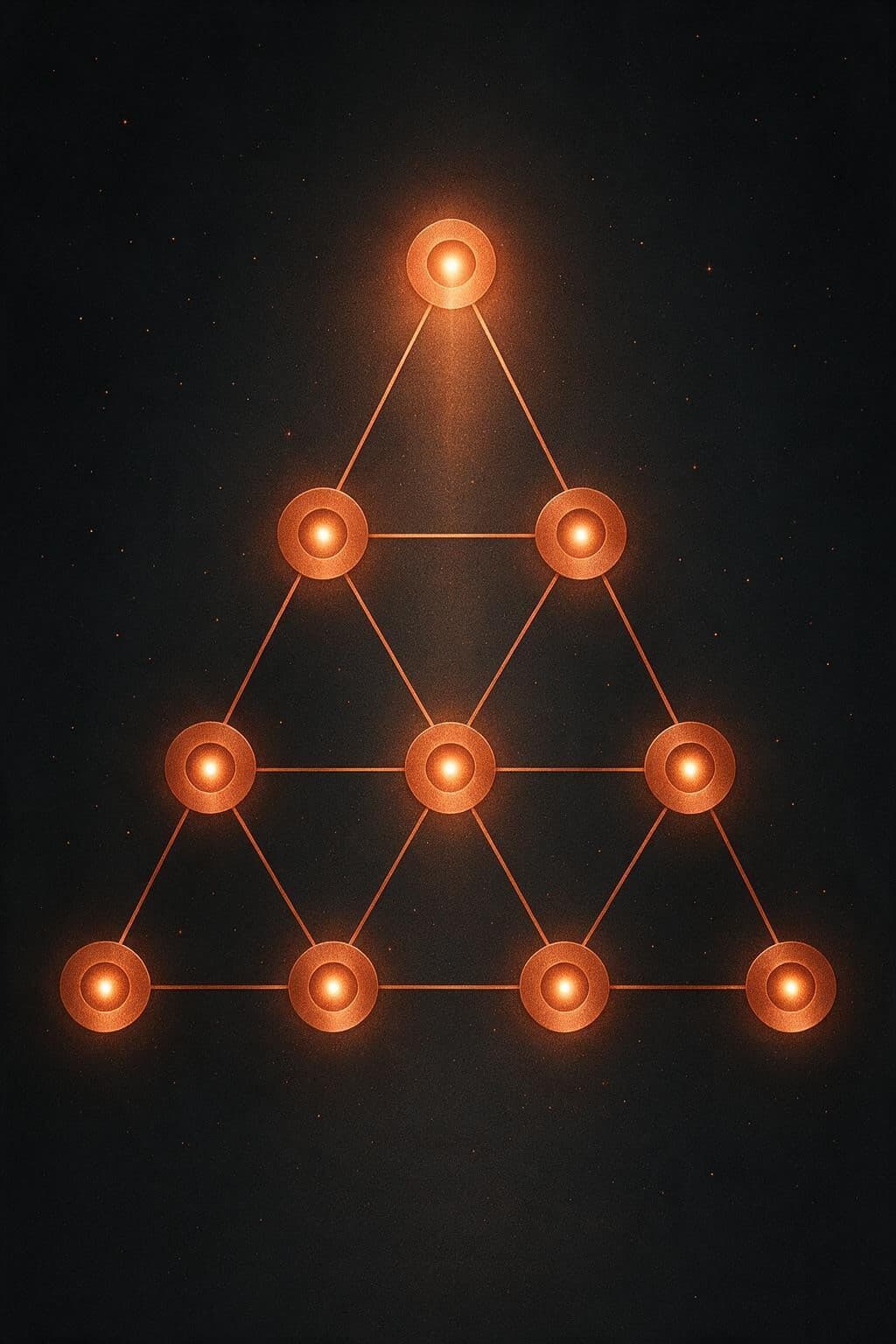
The circle with its centre stands for the sun, which lights and holds every body in its system, and therefore for the one God: its number is 1. The triangle stands for humanity as spirit, soul and body: its number is 3. The cross is only the cube unfolded, the sign of matter, and its number is 4.
Behind this sits Swedenborg's Doctrine of Correspondences, which he names in his introduction: for every spiritual force there is a matching material form. A number is a seal of natural law, he says, as surely as the shape of a flower is.
Sepharial states that there is no causal link between a number in your name or birth date and the events of your life.
TrueCorrect answer
True, and he says it outright: there is "no causative relation" between such a number and any event or trait. What he claims instead is a hidden agreement between the symbol and the life, a correspondence rather than a cause.
Inside the course
12 parts- What Sepharial means by «the kabala of numbers»Free above
- The nine digits, and the characters given to them
- Letters into numbers: the alphabets and their values
- Your name as a number, calculated properly
Questions
Is The Kabala of Numbers free to read in Astra Trainer?
Yes. The full book opens free in the app’s reader, in English, Spanish, German, French, Italian, Polish, Portuguese, and Russian.
What is the short course?
12 short parts that walk through the book’s key ideas in slides, each with a quick quiz. The first six slides are free to try on this page.
Where do I get the app?
Astra Trainer is free on the App Store and Google Play. The Kabala of Numbers is waiting in the app’s library.