Astrology: Your Place in the Sun
Evangeline Adams · 1927
5.0 · 4 ratings
About the book
America's most famous astrologer — she beat a fortune-telling charge in court by reading the judge's son's chart — finally writes her method down. Sign by sign in her plain shrewd voice, with the tables and instructions to cast a horoscope of your own.
Try the short course
Part 1 · The astrologer who won in court. The first six slides, free.

1 / 6
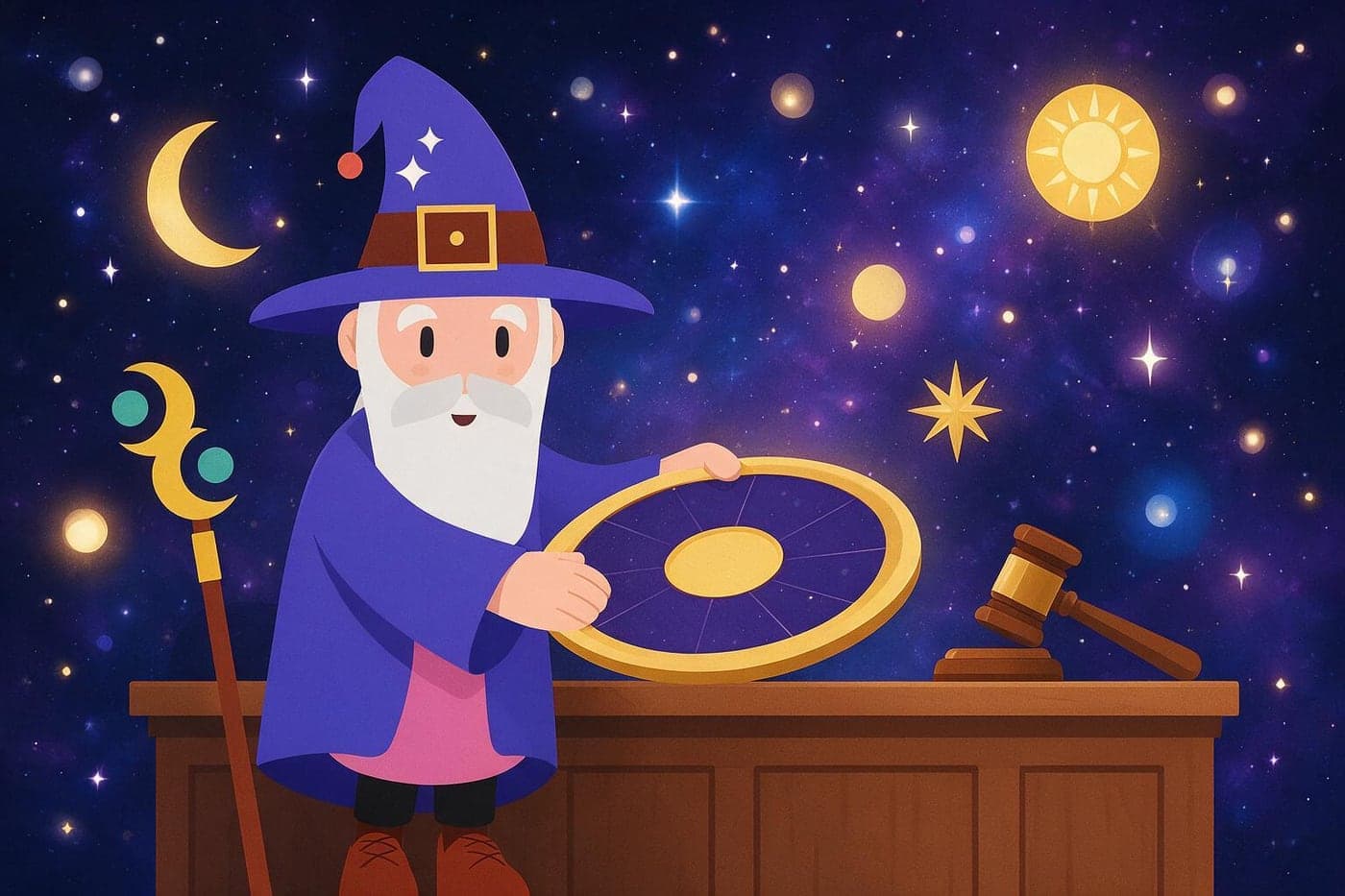
In 1914 Evangeline Adams was brought before a New York court on a charge of fortune-telling. As the story is usually told, the judge gave her the birth data of someone she did not know and asked for a reading. The chart turned out to belong to his own son, the reading fit, and the case was dismissed.
This book never mentions any of that. Written thirteen years later, it does something more useful: it lays out the very distinction that court was being asked to draw, between a person who claims to see your future and a person who reads a map of tendencies.
Hold on to that difference. Nearly everything Adams says in her Foreword is an argument for it.
Read this preview as text
In 1914 Evangeline Adams was brought before a New York court on a charge of fortune-telling. As the story is usually told, the judge gave her the birth data of someone she did not know and asked for a reading. The chart turned out to belong to his own son, the reading fit, and the case was dismissed.
This book never mentions any of that. Written thirteen years later, it does something more useful: it lays out the very distinction that court was being asked to draw, between a person who claims to see your future and a person who reads a map of tendencies.
Hold on to that difference. Nearly everything Adams says in her Foreword is an argument for it.
Adams opens modestly. The book, she says, does not try to teach astrology as a whole, a subject that would fill many volumes. It offers what she gathered in more than thirty years of practice, and it is aimed at practical use.
Then she defines her subject with care. Astrology, for her, is the science that describes how the heavenly bodies influence worldly affairs and human character and life.
Notice the verb. It describes; it does not decree. And notice the word science, which she leans on throughout. For Adams it is not decoration. It is a claim about method: astrology is built from observation, records and calculation, the way other sciences are, and it deserves to be judged on those terms rather than as a gift of second sight.
Adams splits astrology into four branches, and each one asks a different question.
Natural astrology looks at the Sun, Moon and planets acting on tides, weather, seasons and earthquakes. Mundane astrology looks at nations: governments, wars, famines, the fortunes of whole peoples. Natal astrology looks at one person, from the moment of birth to the end of life. Horary astrology draws a chart for the minute someone asks a serious question.
She is frank about who can do what. Natural and Mundane astrology need statistics on a scale no single astrologer could gather; she hands that job to some future endowed organization. For an ordinary person, she says, Natal and Horary are the branches that matter most. That is where this book lives.
Here is the sentence her whole method rests on. Natal astrology can help a person know himself and be forewarned, Adams writes, but “the horoscope indicates tendencies only”.
She finishes the thought precisely. The chart shows what will happen if knowledge and will power are not used, either to avert the evil or to take the opportunity Fate is offering at that moment.
Read it as a conditional, because it is one. A chart describes the course a life takes when nobody steers: the temper that flares, the chance that slips by. It does not say the temper must flare. It says that, left alone, it will. That is the only reason a warning is worth having. A warning about something nobody can change would be useless.
According to Adams, a natal horoscope shows what will happen to you no matter what you choose to do.
FalseCorrect answer
False. She says the horoscope indicates tendencies only: it shows what will happen if knowledge and will power are not used to avert trouble or to seize an opportunity.
Adams calls in the oldest authority she has. Claudius Ptolemy, writing in the second century, warned: “Judgment must be regulated by thyself, as well as by the stars.”
His reason is subtle. The mind can grasp the idea of an event from the sky, he says, but not its particular form. A chart might point toward a loss; it cannot tell you whether the loss will be money, a post or a friend. To get from the idea to the event, the astrologer has to use inference, and only those inspired by the Deity can predict particulars.
So the tradition's own founding authority draws the line Adams wants: the sky gives the kind of event, not its form. Everything after that is the astrologer's judgment, and judgment can be good or bad.
Inside the course
17 parts- The astrologer who convinced a New York courtroomFree above
- Aries, Taurus, Gemini: the first three temperaments
- Cancer, Leo, Virgo
- Libra, Scorpio, Sagittarius
Questions
Is Astrology: Your Place in the Sun free to read in Astra Trainer?
Yes. The full book opens free in the app’s reader, in English, Spanish, German, French, Italian, Polish, Portuguese, and Russian.
What is the short course?
17 short parts that walk through the book’s key ideas in slides, each with a quick quiz. The first six slides are free to try on this page.
Where do I get the app?
Astra Trainer is free on the App Store and Google Play. Astrology: Your Place in the Sun is waiting in the app’s library.