The Key to Your Own Nativity
Alan Leo · 1910
4.8 · 6 ratings
About the book
Leo's promise is in the title: with your birth chart in hand, this book reads it back to you — ruler, rising sign, every planet in every house, money, work, marriage, the lot. Written as the do-it-yourself half of a professional consultation, and it still works as one.
Try the short course
Part 1 · Why Leo thought astrology was reasonable. The first six slides, free.

1 / 6

Leo knew who would pick this book up. Some readers are moved by the sheer size of the subject - the heavens, fate, the stars. Others want to know why any of it should be true before they give it an evening. He wrote his opening page for the second kind: people whose attitude of mind is, in his words, “philosophical rather than devotional.”
So he does something unusual for an astrologer in 1910. He sets the grandeur aside on purpose and argues from what he calls the dispassionate standpoint of pure reason.
That choice shapes everything after it. Before the book tells you a single thing about your rising sign, it wants you to see what kind of claim a birth chart is actually making.
Read this preview as text
Leo knew who would pick this book up. Some readers are moved by the sheer size of the subject — the heavens, fate, the stars. Others want to know why any of it should be true before they give it an evening. He wrote his opening page for the second kind: people whose attitude of mind is, in his words, “philosophical rather than devotional.”
So he does something unusual for an astrologer in 1910. He sets the grandeur aside on purpose and argues from what he calls the dispassionate standpoint of pure reason.
That choice shapes everything after it. Before the book tells you a single thing about your rising sign, it wants you to see what kind of claim a birth chart is actually making.
His first principle is short enough to fit on a card. The universe is exactly what the word says: a unity. And a law that shows itself in one corner of it must be at work throughout the whole.
This is not a claim that something special happens in the sky. It is a claim that nothing is exempt. If a law is real out among the planets, it cannot switch off at the edge of your skin.
Everything else in the book hangs from this one sentence. Grant it, and the rest follows with surprising logic. Refuse it, and no amount of detail about Mars in the tenth house will ever persuade you.
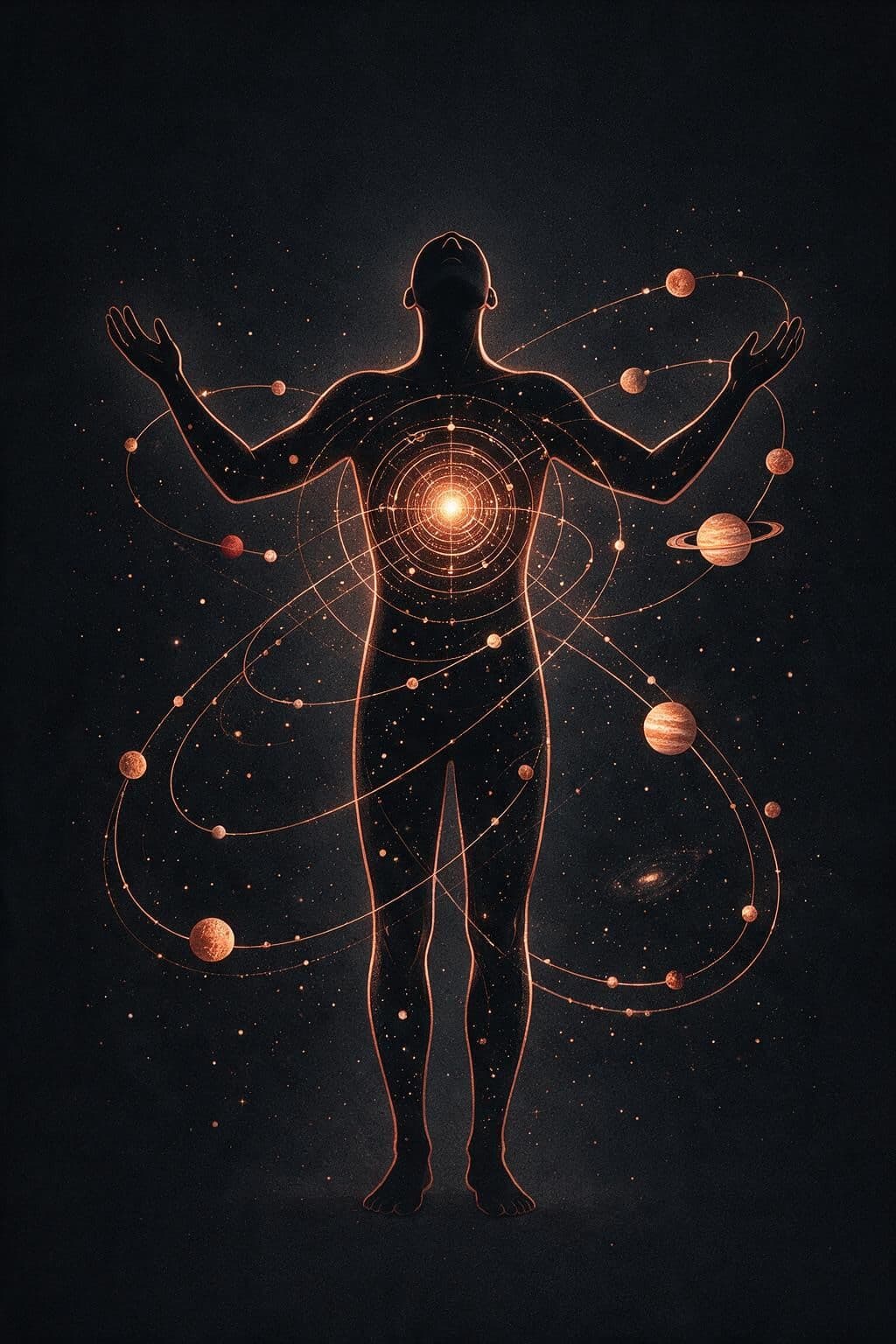
Then Leo narrows the circle. Our solar system is itself a complete whole, so the laws working among its largest members, the planets, are also in force among its smallest ones. He names them plainly: “ourselves, and the other objects on this earth.”
He means everything — solid, fluid or gaseous, human, animal, vegetable or mineral. A person is not a spectator of the planetary pattern but a small part of the same system, running on the same rules.
Notice what this page does not say. It does not picture planets reaching down and pushing people about. It describes one set of laws visible at two scales: huge and slow in the sky, small and close in a single human life.
According to Leo's first principle, the laws at work among the planets are equally in force in a plant or a lump of rock.
TrueCorrect answer
True. He extends the principle to everything on earth, “whether human, animal, vegetable or mineral.” On this view astrology is not a special rule for people — people are simply one of the places where a universal law can be read.
The second principle turns a belief into a method. By studying the motions and relative positions of the planets, Leo says, the working of those universal laws “may be observed, measured, and determined.”
The planets, in other words, are the visible dial. You cannot watch a law operating directly inside your temperament, but you can note where Mars stood when you were born and what angle it made to Saturn.
This is why Leo splits the craft in two. Casting a horoscope is, he says, “in itself a mere question of reckoning” — arithmetic with tables. Judging a nativity, reading what those positions mean, is the real skill, and he insists that anyone can learn a fair measure of it in a short while.
A sceptic might expect Leo to say astrology should now be rebuilt from scratch by observation. He says the opposite. Working from the two principles alone, an astrologer would face a Herculean task of observation, tabulation and induction before knowing as much as a beginner with a decent textbook.
The shortcut is tradition. The learning of the ancients, handed down largely in the form of myth, is of the greatest value to the modern student — because, as he puts it, “Truth is the same in all times.”
He also claims the check runs every day: the old attributes of Mars, Venus, Jupiter and Saturn keep matching what astrologers observe. Reason explains why astrology can work; tradition supplies what it has already found.
Inside the course
20 parts- The rational basis of astrology, stated up frontFree above
- A king's nativity as the worked example
- The ascendant: the self you lead with
- The ruling planet, and how to find yours
Questions
Is The Key to Your Own Nativity free to read in Astra Trainer?
Yes. The full book opens free in the app’s reader, in English, Spanish, German, French, Italian, Polish, Portuguese, and Russian.
What is the short course?
20 short parts that walk through the book’s key ideas in slides, each with a quick quiz. The first six slides are free to try on this page.
Where do I get the app?
Astra Trainer is free on the App Store and Google Play. The Key to Your Own Nativity is waiting in the app’s library.