The Kabbalah Unveiled
S. L. MacGregor Mathers · 1887
4.8 · 5 ratings
About the book
Mathers' introduction is the clearest thing written in English about the sephiroth in the nineteenth century; the three Zoharic texts that follow are among the strangest. Together they are where the Golden Dawn got its entire kabbalah.
Try the short course
Part 1 · What Mathers meant by Kabbalah. The first six slides, free.


1 / 6
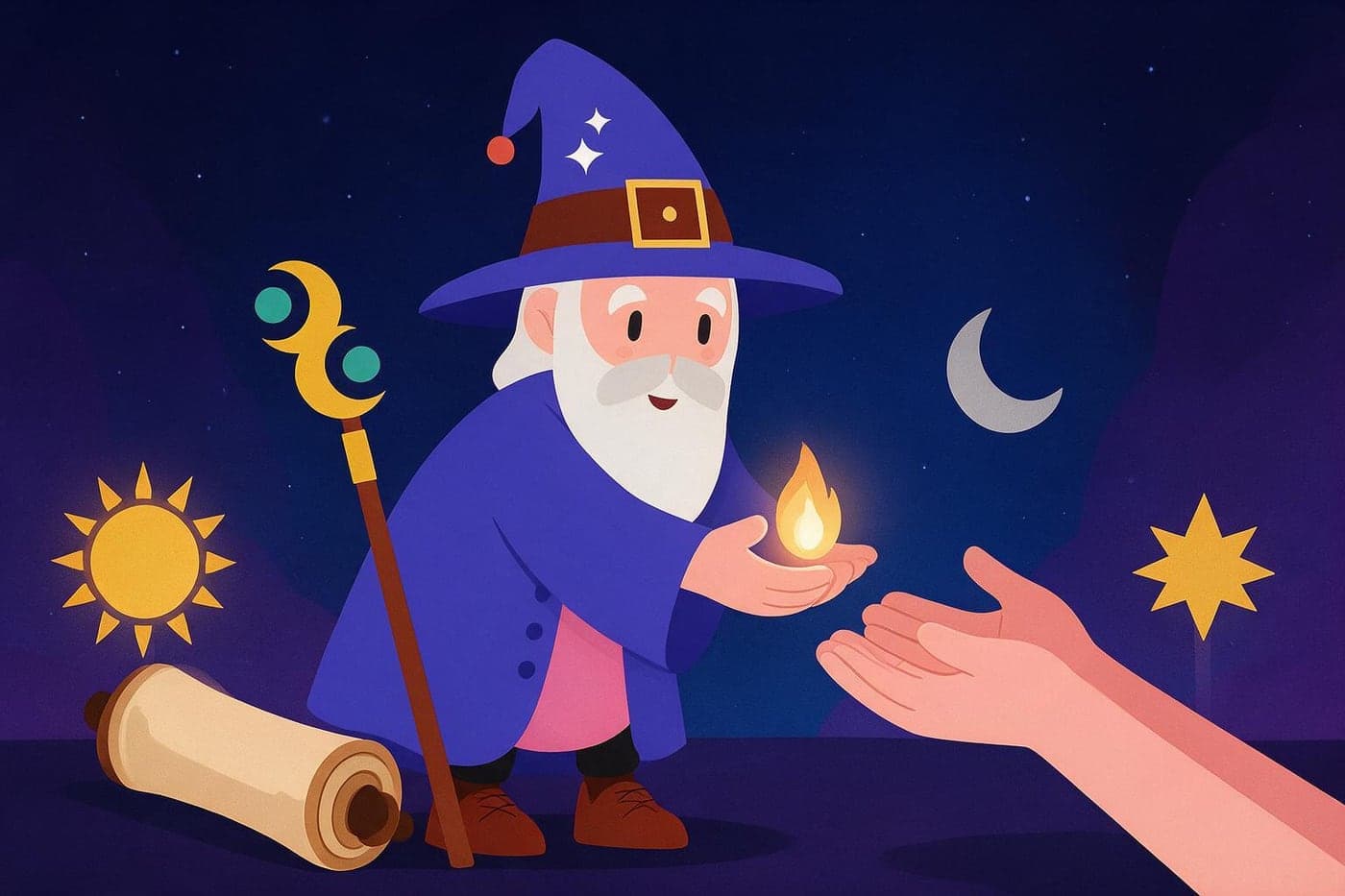
Mathers starts with the word itself. In Hebrew it is QBLH, Qabalah, from the root QBL, “to receive.” He spells it with a Q on purpose, because that sits closer to the Hebrew letters than Cabala or Kabbala does.
The name tells you what kind of knowledge this claims to be. Not a system somebody worked out at a desk, but something handed down and received, passed by mouth from teacher to student. Mathers says the word is close kin to “tradition.”
So whenever you meet the word in this book, hear a chain of people standing behind it. The authority of the teaching rests on who gave it to whom, not on anyone’s cleverness.
Read this preview as text
Mathers starts with the word itself. In Hebrew it is QBLH, Qabalah, from the root QBL, “to receive.” He spells it with a Q on purpose, because that sits closer to the Hebrew letters than Cabala or Kabbala does.
The name tells you what kind of knowledge this claims to be. Not a system somebody worked out at a desk, but something handed down and received, passed by mouth from teacher to student. Mathers says the word is close kin to “tradition.”
So whenever you meet the word in this book, hear a chain of people standing behind it. The authority of the teaching rests on who gave it to whom, not on anyone’s cleverness.
His one-line definition is plain: the Qabalah is “the esoteric Jewish doctrine.” Esoteric means inward, kept for those prepared to receive it, as opposed to the open teaching of the law that anyone can hear.
It is not a separate religion and not a rival scripture. It is an inner reading of the same Bible: the familiar Torah, read so that its names, numbers and strange passages open onto a hidden account of God and creation.
That is why Mathers spends so many pages on single words and even single letters. For a Qabalist the surface of the text is real, but it is the first layer, not the last.
Mathers derives the name Qabalah from the Hebrew root QBL. What does the name itself say about this kind of knowledge?
- It is a philosophy reasoned out by medieval Jewish scholars
- It is a doctrine received and handed down, teacher to studentCorrect answer
- It is a secret code hidden inside the letters of scripture
- It is a set of magical rites performed to receive power
QBL means “to receive,” and Mathers ties the word to oral transmission and to tradition. Letter codes and magic are real branches of the Qabalah, but the name points to receiving, not to decoding or doing.
Mathers does not tell the origin story in his own voice. He borrows it from Dr. Ginsburg’s Essay on the Kabbalah, which gives it as the followers tell it, and it is a wonderful story.
God first taught the Qabalah to a school of angels in Paradise. After the Fall the angels passed it to Adam, so that humanity had a way back. It went to Noah, then to Abraham, who let some of it leak out in Egypt, and to Moses, who hid its principles in the first four books of the Torah and held them back from Deuteronomy.
Then comes the detail that matters for this book: no one dared to write it down until Rabbi Simeon ben Yochai, around the fall of the Second Temple. After his death, his son and his secretary gathered his teachings into the Zohar.
Mathers sorts the whole tradition under four heads: practical, literal, unwritten and dogmatic. The first two are the ones most people picture.
The practical Qabalah deals with talismanic and ceremonial magic. In the very next sentence he says it does not come within the scope of this work. From a man who gave his life to ceremonial magic, that restraint is worth noticing: this book is doctrine, not a spellbook.
The literal Qabalah is the work with letters. Hebrew has no separate numerals, so every letter is also a number, and in Mathers’s phrase “every word is a number, and every number is a word.” Its three methods, gematria, notariqon and temura, get their own part later in the course.
The unwritten Qabalah is knowledge that is never put on paper, only passed on orally. Mathers adds one of the most teasing lines in the book: he may say no more on it, “not even whether I myself have or have not received it.”
The dogmatic Qabalah is the written doctrine, and it is what this book is really about. He reduces its many treatises to four families: the Sepher Yetzirah, or Book of Formation, with its ten numbers and twenty-two letters; the Zohar and its commentaries; the Sepher Sephiroth; and the alchemical Asch Metzareph.
So the map has a written half and a silent half. Everything you read here belongs to the first, and the author makes sure you know the second exists.
Inside the course
20 parts- What Mathers meant by «the Kabbalah», and where he got itFree above
- Ain Soph, and the negative existence before the first point
- The ten sephiroth, one at a time
- The four worlds, from Atziluth down to Assiah
Questions
Is The Kabbalah Unveiled free to read in Astra Trainer?
Yes. The full book opens free in the app’s reader, in English, Spanish, German, French, Italian, Polish, Portuguese, and Russian.
What is the short course?
20 short parts that walk through the book’s key ideas in slides, each with a quick quiz. The first six slides are free to try on this page.
Where do I get the app?
Astra Trainer is free on the App Store and Google Play. The Kabbalah Unveiled is waiting in the app’s library.