The Secret Doctrine
H. P. Blavatsky · 1888
5.0 · 3 ratings
About the book
Blavatsky's enormous map of how a universe is born, drawn from a poem she said was older than humanity. Nobody reads it cover to cover; everyone in the occult world ends up arguing with it anyway.
Try the short course
Part 1 · Why Blavatsky Built This Book. The first six slides, free.


1 / 6
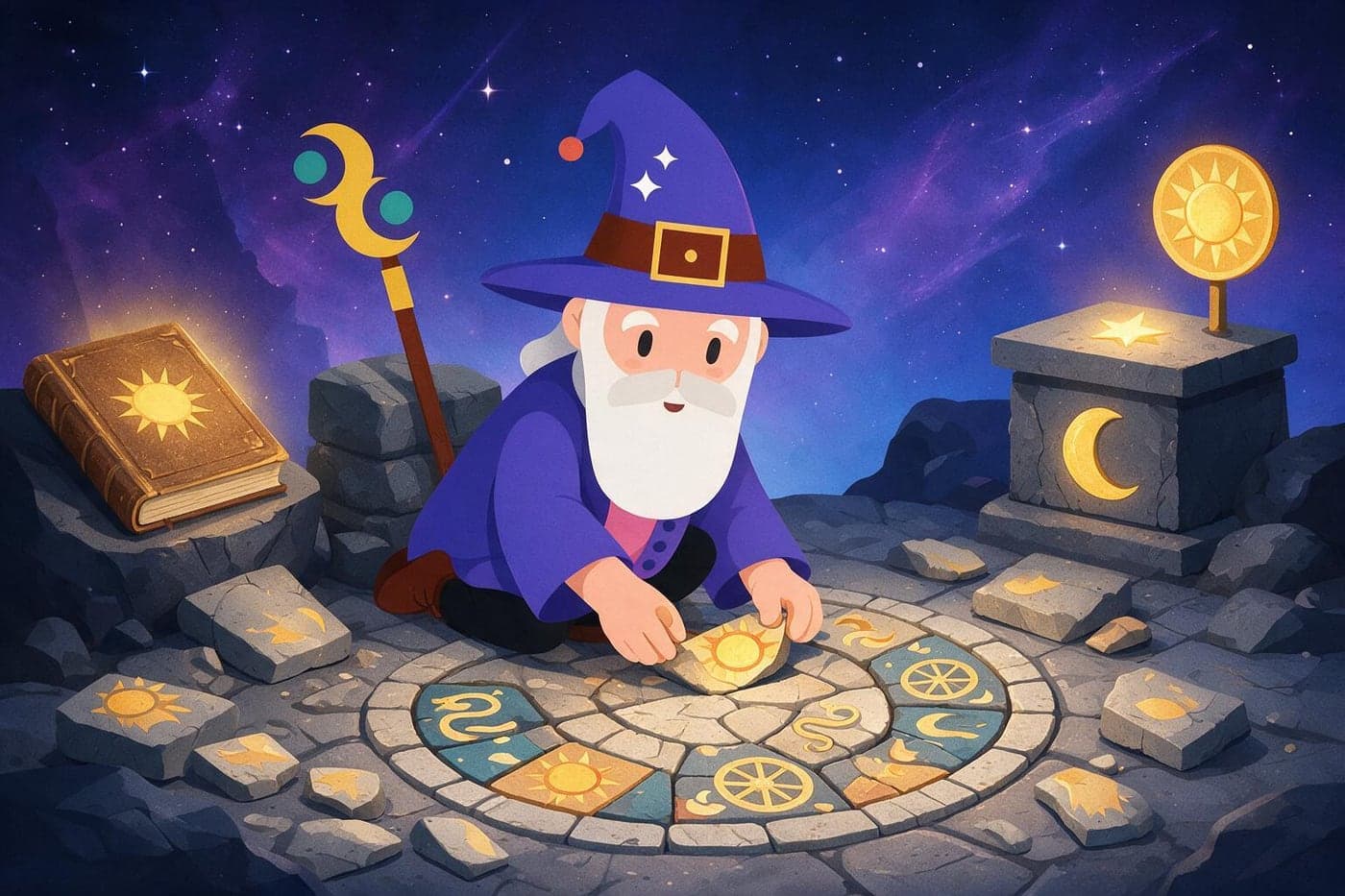
Blavatsky opens with a revealing correction: “The author-the writer, rather-”. She refuses the role of someone inventing a system and presents herself as transmitting material that already exists.
That does not make her a neutral editor. She selects sources, interprets symbols, and argues that scattered teachings belong together. Her claim is not “I discovered this,” but “I assembled what was dispersed.”
This distinction explains the book’s unusual authority: its voice is forceful, yet the authority is said to come from an inherited tradition rather than personal inspiration.
Read this preview as text
Blavatsky opens with a revealing correction: “The author—the writer, rather—”. She refuses the role of someone inventing a system and presents herself as transmitting material that already exists.
That does not make her a neutral editor. She selects sources, interprets symbols, and argues that scattered teachings belong together. Her claim is not “I discovered this,” but “I assembled what was dispersed.”
This distinction explains the book’s unusual authority: its voice is forceful, yet the authority is said to come from an inherited tradition rather than personal inspiration.
Which description best matches Blavatsky’s stated role in the book?
- A compiler arranging inherited fragments into a systemCorrect answer
- A revealer announcing an entirely new doctrine
- An editor lightly expanding her previous book
- A historian cataloguing beliefs without judging them
She presents the work as a compilation and synthesis of older teachings. Yet she is not neutral: she argues that the fragments form a coherent doctrine.
“These truths are in no sense put forward as a revelation,” Blavatsky says. She claims that their traces already survive across scriptures, philosophical writings, symbols, myths, and esoteric commentaries.
Their scattered condition is central to her argument. No single surviving religion or text possesses the entire doctrine openly; portions have been concealed, misunderstood, or preserved beneath symbolic language.
For Blavatsky, making something public is not originating it. The book may disclose teachings to a new audience while still claiming that those teachings are ancient.
A collection merely places fragments beside one another. Blavatsky attempts something more ambitious: “to gather the oldest tenets together and to make of them one harmonious and unbroken whole.”
That word “whole” changes how the book must be read. A Hindu cosmological term, a Greek myth, and a scientific controversy may appear pages apart, yet she treats them as evidence for one underlying account of reality.
Her governing method is therefore synthesis, not anthology. The sources matter because she believes their apparent differences can be interpreted as partial expressions of a common wisdom.
Blavatsky presents The Secret Doctrine as a partial compilation of older teachings rather than a complete revelation originating with her.
TrueCorrect answer
That is her explicit position. She claims to arrange inherited material, and she also admits that the published volumes neither complete nor exhaust the larger scheme.
The subtitle names the book’s three fields: “The Synthesis of Science, Religion, and Philosophy.” Its structure enacts that promise. Cosmogenesis supplies a large account of existence; comparative symbolism connects religious traditions; later sections confront scientific theories.
These are not three independent subjects sharing a binding. Blavatsky wants religious symbols, metaphysical principles, and observations of nature to support one another within a single worldview.
Nor does “synthesis” mean a polite compromise among equal positions. She is proposing one framework across three domains, and she frequently judges rival explanations by whether they fit it.
Inside the course
20 parts- Madame Blavatsky, and why this book existsFree above
- The three fundamental propositions
- The Stanzas of Dzyan: a poem as a map of creation
- An eternity that breathes: days and nights of Brahma
Questions
Is The Secret Doctrine free to read in Astra Trainer?
Yes. The full book opens free in the app’s reader, in English, Spanish, German, French, Italian, Polish, Portuguese, and Russian.
What is the short course?
20 short parts that walk through the book’s key ideas in slides, each with a quick quiz. The first six slides are free to try on this page.
Where do I get the app?
Astra Trainer is free on the App Store and Google Play. The Secret Doctrine is waiting in the app’s library.